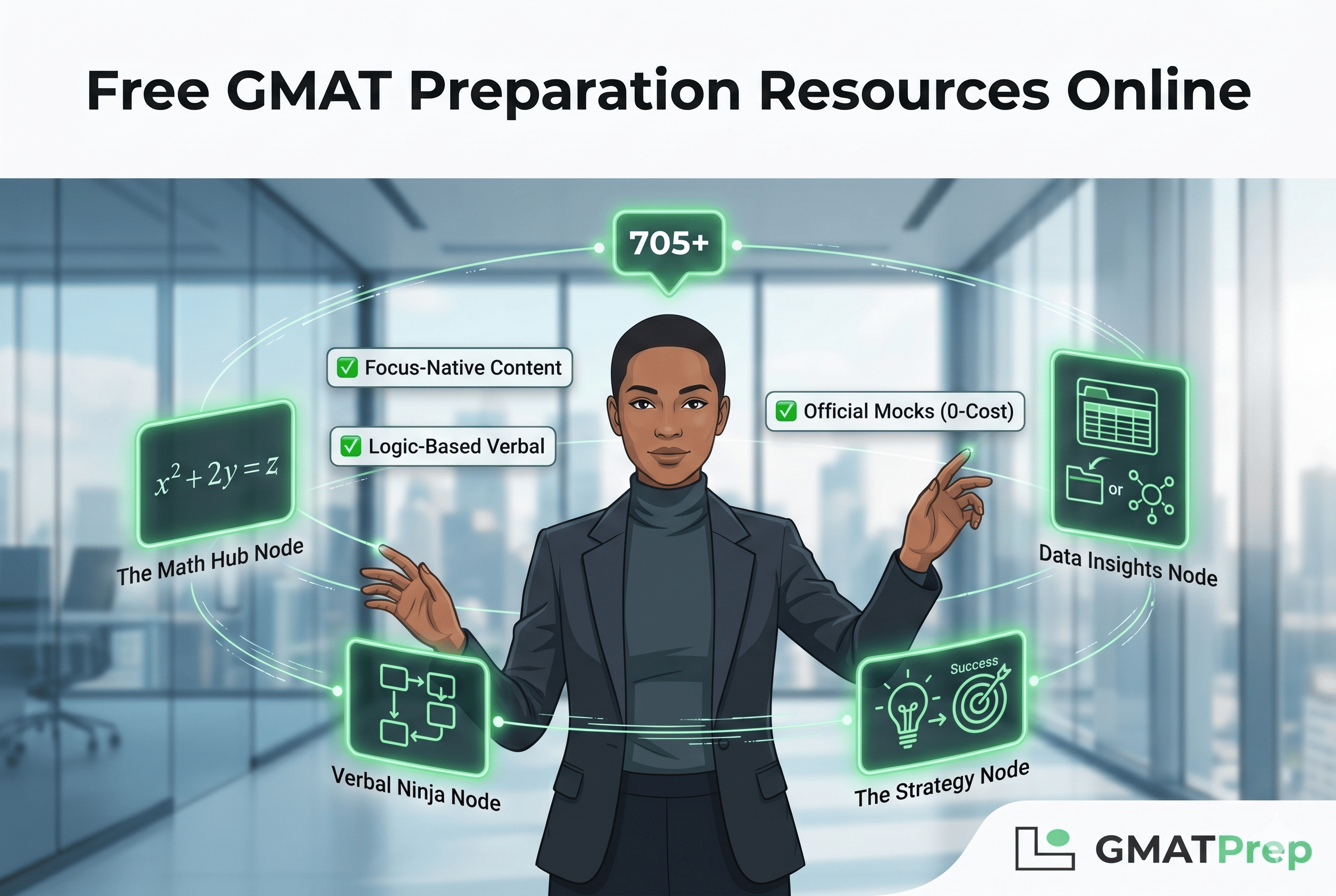
The GMAT Focus Edition is a high-stakes investment. Between registration fees ($275+ depending on your region), MBA application fees, and score reporting, the financial barrier to entry for business school can be significant. However, in 2026, the “Price of Knowledge” has never been lower. While premium coaching and private tutoring offer accelerated results, it is entirely possible to architect a 90th-percentile (705+) score using high-quality free GMAT prep resources—provided you have the executive discipline to filter the signal from the noise.
The challenge today isn’t a lack of information; it’s an abundance of it. If you spend 20 hours “resource hoarding” but only 2 hours studying, you are losing the battle of ROI. This guide is a forensic roundup of the best free resources currently available, structured to help you build a comprehensive study plan from scratch.
1. Understanding the GMAT Focus Structure
Before diving into the tools, you must understand the architecture of the test. The GMAT Focus Edition has eliminated Sentence Correction and Geometry, shifting the weight toward logical reasoning and data synthesis. Your resource list must be “Focus-Native” to be effective.
The exam consists of three sections: Quantitative Reasoning, Verbal Reasoning, and Data Insights. All are equally weighted on a scale of 205 to 805. To succeed with free resources, you must find tools that address each of these three pillars specifically.
2. The “Non-Negotiable” Starter: Official GMAC Resources
Any credible free GMAT prep journey must begin at the source: MBA.com. The Graduate Management Admission Council (GMAC) provides a “Starter Kit” that is essential for setting your baseline.
- The Official Starter Kit: This includes two full-length adaptive practice exams. These are the only free mocks that use the actual GMAT scoring algorithm and retired questions. They are your most valuable free assets—do not “waste” them until you have done at least two weeks of foundational study.
- The GMAT™ Official Guide Sampler: A selection of 70+ questions with explanations. Use these to get used to the “Voice of the Test-Maker.”
- The Official GMAT Focus App: Provides a limited set of free practice questions on the go.
3. Quantitative Reasoning: Building the Math Foundation
The GMAT Focus Quant section (Algebra and Arithmetic) doesn’t test math; it tests logic using math. Free resources for this section abound, but they must be used strategically.
Khan Academy (The Foundational Layer)
While not GMAT-specific, Khan Academy is the gold standard for rebuilding math foundations.
- Focus on: Arithmetic, Algebra I, and Algebra II.
- Why it works: If you can’t remember how to factor a quadratic equation or solve a ratio problem, Khan Academy’s “mastery” system ensures you don’t move forward with gaps in your knowledge.
GMAT Club “Daily Dose” & Math Book
GMAT Club is the largest community-driven resource.
- The Free Math Book: They offer a downloadable PDF that covers every Quant concept tested on the GMAT. It is dense, forensic, and entirely free.
- Problem Sets: Their database allows you to filter thousands of questions by topic (e.g., Number Properties) and difficulty (605-level vs. 705-level).
4. Verbal Reasoning: Master the Argument
Verbal is now 100% Critical Reasoning (CR) and Reading Comprehension (RC).
The Economist & Scientific American (RC Training)
The best way to improve RC is to read what the test-makers read.
- The Strategy: Read one “Long Read” per day from The Economist, The New York Times, or Scientific American.
- The Drill: After reading, summarize the author’s primary purpose and the “pivot points” in the argument. This builds the mental stamina required for the GMAT’s dense, 400-word passages.
Manhattan Prep “Free Starter Kit”
Manhattan Prep offers a free trial of their digital platform.
- What’s included: A significant portion of their “Foundations of Verbal” course is usually available for free. Their “LSAT logic” approach to Critical Reasoning is particularly helpful for those aiming for a 705+ score.
5. Data Insights: Navigating the New Frontier
Data Insights (DI) is the most difficult section to find free resources for because it is relatively new. It requires synthesizing charts, tables, and logic.
GMATPrep.in Diagnostic Tools
Many modern platforms offer a “Diagnostic DI Session” for free.
- What to look for: Practice Data Sufficiency (DS) and Table Analysis specifically. DS was previously in the Quant section but has moved to DI, making it easier to find “Legacy” free questions that are still valid for DS.
YouTube Strategy Channels
YouTube has become a primary hub for free GMAT prep strategy.
- GMAT Ninja: Widely regarded as the best free Verbal instructor. His playlists on “Critical Reasoning” and “Reading Comprehension” provide a framework that most paid courses can’t match.
- Target Test Prep (TTP) Webinars: They frequently host free live sessions on YouTube covering specific DI types like Multi-Source Reasoning.
6. Community & Collective Intelligence
Studying in isolation is a mistake. Using community resources provides the “Coaching” element for free.
- Reddit (r/GMAT): A great place for “Score Debriefs.” Read the stories of those who reached 705+ to see which free schedules they followed.
- Beat The GMAT: Another veteran forum with free “60-Day Study Plans” that curate free links and resources into a structured timeline.
7. The “Hidden Costs” of Free: A Strategic Warning
While the resources above are high-quality, “Free” often comes with three significant tactical risks:
A. The Analytics Gap
Free resources rarely provide “Cross-Sectional Analytics.” They can tell you if you got a question right, but they can’t tell you why your timing is slow in Quant but fast in Verbal. This “Blind Spot” can lead to plateaus.
B. The Fragmented Logic
If you learn CR strategy from one person and RC strategy from another, your “Verbal Voice” becomes fragmented. A unified platform ensures that the logic you use in one section reinforces the logic in another.
C. The Legacy Trap
Many free PDFs floating around the web are for the “Old GMAT.” If you spend time studying Geometry or Sentence Correction, you are wasting the most precious resource of all: your time.
8. Putting it All Together: The 0-Cost Study Plan
How do you turn this roundup into a result? Follow this 4-week foundation-building plan using only free resources:
- Week 1 (Basics): Complete Khan Academy Algebra I and download the GMAT Club Math Book. Take the first Official GMAT Focus Practice Exam (Mock 1) to set your baseline.
- Week 2 (Verbal): Watch the GMAT Ninja CR playlist. Read 5 Economist articles. Practice 20 free RC questions on a community forum.
- Week 3 (DI & DS): Focus exclusively on Data Sufficiency and Graphics Interpretation via YouTube webinars and free platform diagnostics.
- Week 4 (The Simulation): Re-solve all questions you missed in Mock 1. Update your Error Log (use a free Excel template). If your score is within 50 points of your goal, take the second Official Mock.
9. Conclusion: Strategy Over Volume
The GMAT Focus Edition is not a test of how much you can memorize; it is a test of how you manage your cognitive resources. A student with three high-quality free resources and a rigorous Error Log will consistently outperform a student with ten paid books and no strategy.
Free resources are the “Raw Materials.” Your discipline is the “Architecture.” By using the official tools for simulation, Khan Academy for foundations, and expert community forums for strategy, you can bridge the gap to a 705+ without a massive financial burden.
However, once you have built your foundation, the next step is to test your skills in a high-fidelity environment that mirrors the actual exam’s adaptive behavior.
Start Free Practice Today
Ready to move from “Resource Gathering” to “Result Building”? Our platform offers a Free Diagnostic Tier designed specifically for the GMAT Focus Edition. Get access to high-fidelity practice questions, a version of our executive study plan, and a preview of the analytics that top scorers use to identify their weak spots.
Leave a Reply