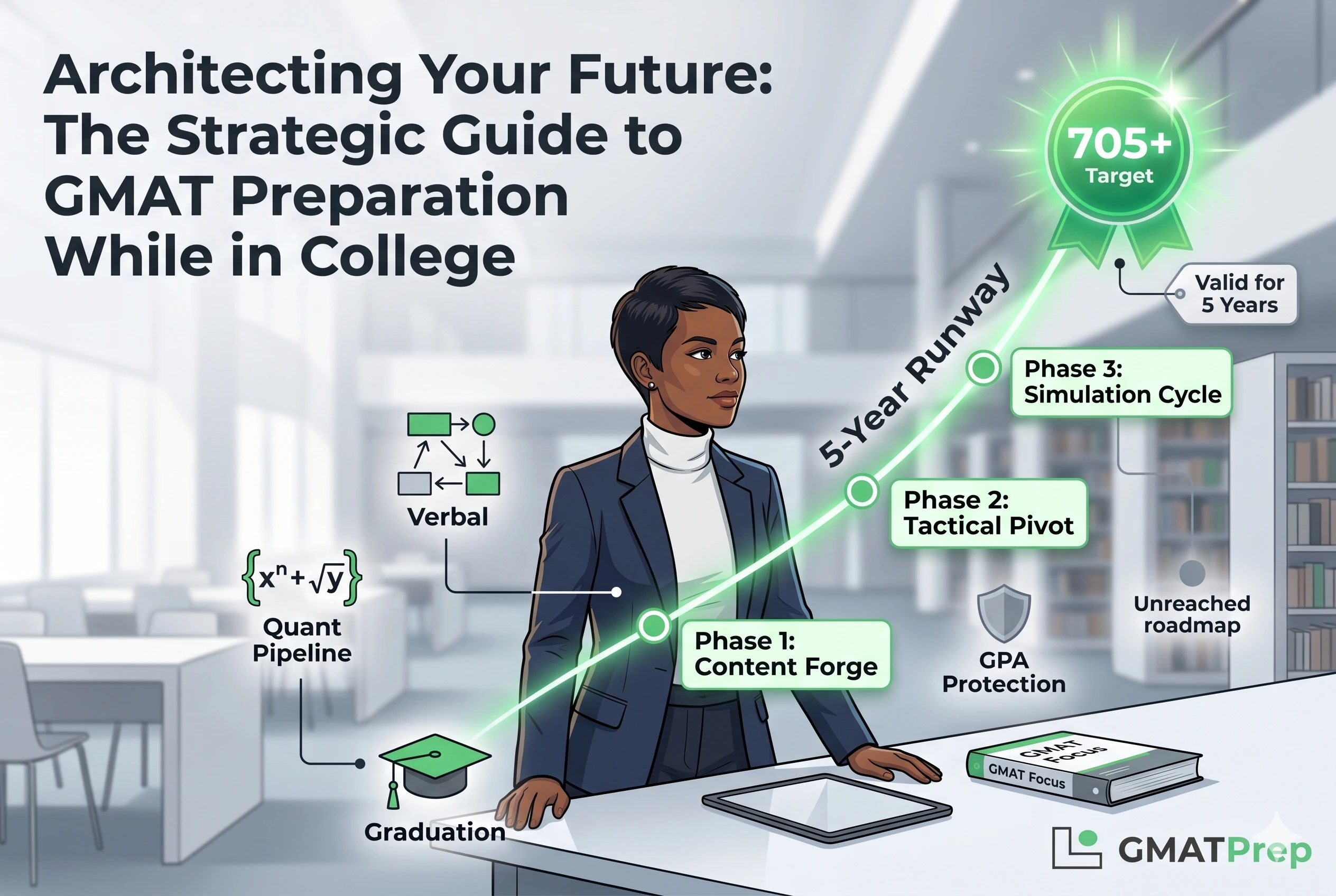
In the high-stakes theater of global MBA admissions, the “Strategic Architect” doesn’t wait for professional burnout to begin their journey. They recognize that the undergraduate years represent a unique window of cognitive peak—a period where the brain is already wired for disciplined study, logical analysis, and high-performance testing.
Preparing for the GMAT while in college is more than just an “early start”; it is a tactical maneuver designed to capture your maximum academic momentum. With GMAT scores remaining valid for five years, a 705+ score earned in your senior year becomes a golden ticket that you can carry into your early professional life.
This is your forensic roadmap to navigating the GMAT Focus Edition without compromising your GPA.
1. The “Early Mover” Advantage: Why Now?
Most GMAT aspirants wait until they have 3–5 years of work experience. By that time, the “academic muscles”—the ability to sit for hours in a library, the speed of mental math, and the habit of reading dense academic texts—have often atrophied.
As a college student, you have three distinct advantages:
- Cognitive Conditioning: You are already in “learning mode.” Your brain is accustomed to absorbing new frameworks and being evaluated.
- Recent Quant Exposure: If you are in a STEM or business major, your algebra and arithmetic foundations are likely fresher than those of a professional who hasn’t seen an equation in five years.
- The 5-Year Runway: Taking the GMAT now provides a safety net. If you don’t hit your target, you have years to retake it before you actually need to apply to business school.
2. The Forensic Audit: Your Starting Point
Before you dive into textbooks, you must establish your “Survey Markers.” You cannot architect a roadmap if you don’t know your current location.
The Diagnostic Mock
Take an official GMAT Focus practice exam under timed, realistic conditions. Do not study for it first. This diagnostic serves as your forensic baseline. For a student, it reveals:
- The Content Gap: Did your college math cover GMAT-specific logic?
- The Stamina Profile: Can you maintain focus for the full 2 hours and 15 minutes?
- The Timing Signature: Are you rushing because of “test anxiety” or dragging because of “over-analysis”?
3. The 12-Week “Strategic Architect” Student Study Plan
Balancing a full course load with GMAT prep requires a phase-based approach. We have engineered this plan to fit into a typical semester or summer break.
Phase 1: The Content Forge (Weeks 1–4)
- Focus: Rebuilding foundations.
- Quant: Master the “Logic of Numbers.” Revisit algebra and arithmetic through the lens of GMAT traps, not just calculations.
- Verbal: Learn “Argument Anatomy.” Don’t just read; map the logic.
- DI: Familiarize yourself with multi-source reasoning.
Phase 2: The Tactical Pivot (Weeks 5–8)
- Focus: Bridging the gap between “knowing” and “solving.”
- The Error Log: This is non-negotiable. Every mistake must be forensically analyzed. Why was the distractor answer appealing? What was the logical “tripwire”?
- Weekly Quizzes: Start taking 30-minute timed sets to build a 2-minute-per-question rhythm.
Phase 3: The Simulation Cycle (Weeks 9–12)
- Focus: High-fidelity execution.
- Full Mocks: Take one official mock per week in the exact same environment where you will take the real test.
- The “Bail-out” Rule: Practice knowing when to guess and move on to protect your pacing.
4. Reconstructing Verbal Reasoning: A Student’s Guide
For many college students, the Verbal section is the most misunderstood. It is not a test of vocabulary; it is a test of Argument Architecture.
Critical Reasoning (CR)
In CR, you must learn to strip away the “fluff” to see the bones of the argument. Every prompt has a Premise, a Conclusion, and a hidden Assumption.
- The Student Edge: Use your experience with academic papers to identify “evidence” versus “claims.”
Reading Comprehension (RC)
RC on the GMAT Focus is about “Vertical Reading.” You aren’t reading for facts; you are reading for Authorial Intent.
- Strategy: Map the passage. Paragraph 1 introduces a theory; Paragraph 2 provides evidence; Paragraph 3 introduces a counter-point.
5. The Quant Advantage: Beyond Calculations
Students often over-rely on their math skills. The GMAT Focus Quant section is an Executive Reasoning test conducted in the language of math.
- Logic over Arithmetic: If you are doing long division, you missed the shortcut. The GMAT tests properties (even/odd, positive/negative, prime/composite) more than raw calculation.
- Data Sufficiency (DS): This is now housed in Data Insights. It is the ultimate test of “Is this information enough?” It requires a level of restraint that many high-achieving students find difficult.
6. Balancing the Act: GMAT vs. GPA
The biggest risk for a student is “Decision Fatigue.” If you spend all day in class, your brain might be too tired for GMAT logic at 8:00 PM.
The “Gap Analysis” Schedule
- Morning Rituals: Dedicate 45 minutes to your weakest GMAT section before your first college class. This ensures you are giving the GMAT your “Peak Cognitive Energy.”
- Weekend Sprints: Use Saturdays for high-density study—the forensic review of your error log and mock exams.
- Academic Synergy: If you are taking a statistics or logic class, look for overlaps with GMAT Data Insights.
7. The Terminal Goal: The 705+ Milestone
The GMAT Focus Edition rewards the “Strategic Architect”—the person who understands that the test is an engineering project. By starting in college, you are giving yourself the luxury of time and the advantage of academic momentum.
When you walk into the testing center, your goal isn’t to “pass”; it’s to execute a Master Plan that you have spent 12 weeks refining.
Ready to Begin Your Undergraduate Audit?
The journey to an elite score begins with data, not guessing. Leverage your current academic momentum and start your forensic roadmap today.
Leave a Reply