Most GMAT students treat a mock test like an exam. They take it, check the score, feel good or bad, and book the next one.
But a mock is a diagnostic tool. The score tells you where you are. The review tells you how to improve. Two students with the same score can end up 60 points apart a month later, and the difference is usually what each did in the hours after their mocks.
Here’s a five-step review method you can use after every full-length mock.
Step 1: Review within 24 hours
Take a short break after the mock. Your brain needs it. But do the review the same day or the next morning, while you still remember what you were thinking on each question. Give it about as much time as the mock took, roughly two hours.
Step 2: Sort every question into four groups
Go through all 64 questions and put each one into a group:
| Group | What it means | Review it? |
|---|---|---|
| Wrong | You got it wrong | Yes, every one |
| Guessed | You got it right, but weren’t sure | Yes. Next time the guess may miss. |
| Slow | You got it right, but it took over about 3 minutes | Yes. It cost time you needed elsewhere. |
| Solid | Right, confident and on time | No. Skip it. |
Most students review only the first group. The guessed and slow questions are just as important, because they’re where your next mistakes and your time trouble will come from.
Step 3: Find the real cause of each mistake
“Silly mistake” isn’t a cause. For every question you review, redo it untimed first. Then decide which of these four went wrong:
- Concept gap. You didn’t know the rule, formula or reasoning pattern. Fix: learn it, then do five to ten similar questions.
- Process error. You knew the material but made a slip, such as an arithmetic error, a dropped negative sign or an answer choice you didn’t check. Fix: build a habit that catches it, such as checking units or rereading the question before you choose.
- Misreading. You answered a different question from the one asked, or missed a word like “not” or “except.” Fix: restate the question in your own words before you solve.
- Timing. You could solve it, but not fast enough, or you spent so long that you rushed later questions. Fix: practise timed sets of that type, and set a point where you guess and move on.
Be honest here. If you label everything as careless, you’ll never fix the concept gaps hiding underneath.
Step 4: Write it down in an error log
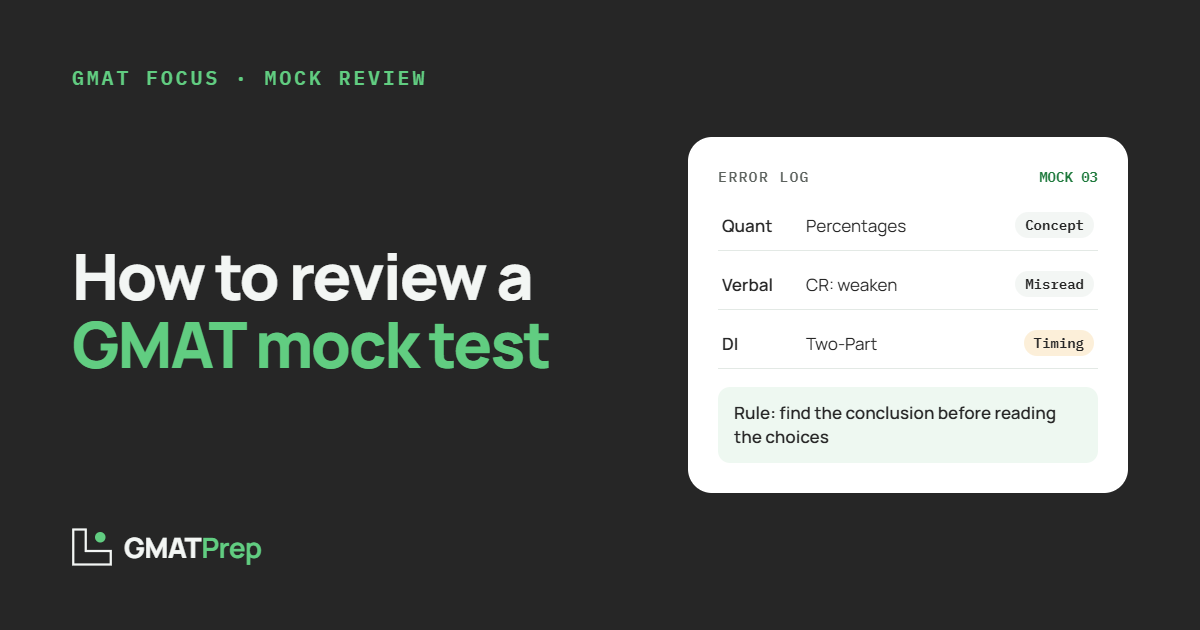
An error log turns one-off mistakes into patterns you can see. A simple spreadsheet works. Use these columns:
| Date | Section | Question type | Group | Cause | Rule for next time |
|---|---|---|---|---|---|
| 24 Oct | Quant | Percentages | Wrong | Concept gap | A rise of x% then a fall of x% gives a net loss |
| 24 Oct | Verbal | Critical Reasoning: weaken | Guessed | Misreading | Find the conclusion before reading the answer choices |
| 24 Oct | Data Insights | Two-Part Analysis | Slow | Timing | Test the answer options instead of solving from scratch |
The last column matters most. Write the rule as an instruction to your future self, short enough to remember on test day.
Step 5: Turn patterns into next week’s plan
Once your log has entries from two or three mocks, look for repeats. Three or more entries with the same question type or the same cause tell you exactly what to study next. That’s far more useful than “do more Quant.”
Two more things are worth checking after every mock.
Your timing by section. You have about 2 minutes per Quant question, 2 minutes per Verbal question and 2 minutes 15 seconds per Data Insights question. If you rushed or guessed on the last few questions of a section, pacing is costing you more points than content is. Practise timed sets until you finish each section with a minute to spare.
Your answer changes. The GMAT Focus Edition lets you change up to three answers per section. Count how many changes you made and whether they turned wrong answers into right ones. If most of your changes made things worse, trust your first answer more often.
Then take your next mock in one to two weeks, after you’ve worked on the patterns. Taking mocks back to back without fixing anything mostly measures the same mistakes twice.
The score is the start, not the result
A careful review takes about two hours. It’s often the most valuable two hours of your study week, because it shows you exactly where your next points will come from.
GMATPrep’s mock reports do the first part of this work for you. They break down your score by section and question type and show where your time went, so you can go straight to finding causes and fixing them. Take a free full-length mock at gmatprep.in and use this method on your results.
Leave a Reply