The landscape of business school admissions underwent a seismic shift with the introduction of the GMAT Focus Edition. This streamlined, data-centric version of the exam replaced the “Classic” GMAT, bringing with it a new GMAT format that demands a fresh approach to preparation. At the heart of this preparation lies one indispensable tool: the GMAT Focus mock.
In this comprehensive guide, we will explore everything you need to know about navigating GMAT Focus practice tests in 2025. Whether you are just beginning your journey or are in the final stages of fine-tuning your strategy, understanding the nuances of these mocks is the key to unlocking a 705+ score.
Section 1: Understanding the New GMAT Format
Before diving into mocks, it is crucial to understand what you are actually testing. The Focus Edition isn’t just a shorter version of the old test; it is a fundamental reimagining of what a business school entrance exam should measure.
What’s In and What’s Out?
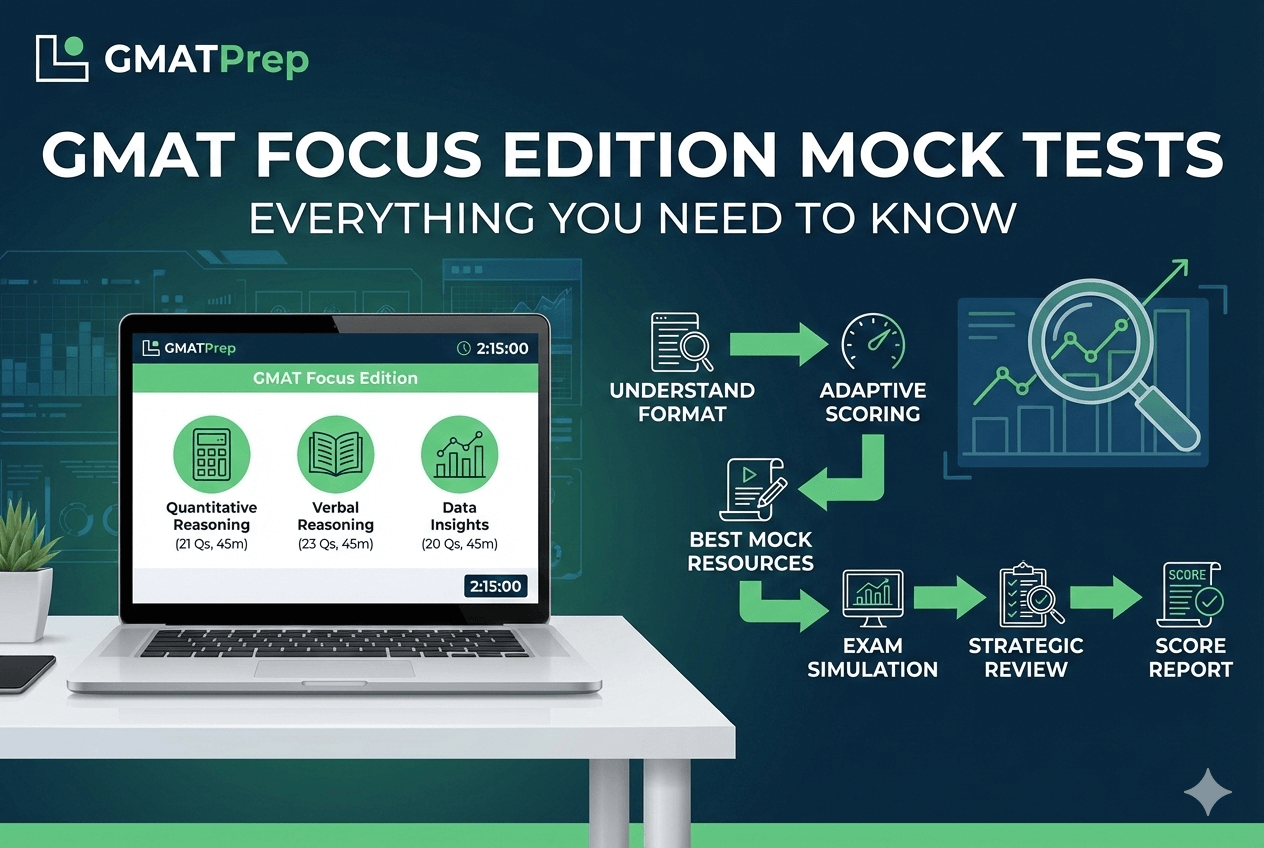
The new GMAT format consists of three 45-minute sections:
- Quantitative Reasoning: Gone is Geometry. The focus is now entirely on Arithmetic and Algebra.
- Verbal Reasoning: Sentence Correction has been eliminated. You are now tested solely on Reading Comprehension and Critical Reasoning.
- Data Insights (DI): This is the biggest change. It incorporates Data Sufficiency (moved from Quant) alongside Integrated Reasoning task types like Graphics Interpretation and Multi-Source Reasoning. Crucially, DI is now a permanent, scored part of your total result.
Because the sections are shorter and the content is more focused, the margin for error is slimmer. This is why a high-quality GMAT Focus mock is your most valuable asset—it trains you for the specific “sprints” required by this new structure.
Section 2: Why Every GMAT Focus Mock Matters
Taking a GMAT Focus practice test is not just about seeing a three-digit number. It serves as a laboratory for your test-taking behavior. In the Focus Edition, three factors determine your success: Accuracy, Pacing, and Adaptivity.
1. Training the Adaptive Mindset
The GMAT is a Computer Adaptive Test (CAT). Your performance on early questions dictates the difficulty of the later ones. If you take a linear, non-adaptive mock, you aren’t actually preparing for the GMAT. A true GMAT Focus mock forces you to experience the “pressure cooker” effect where the questions get progressively harder as you succeed.
2. Mastering the Question Review Feature
One of the most significant additions to the Focus Edition is the ability to bookmark questions and change up to three answers per section at the end (if time permits). You cannot learn how to use this feature effectively by doing practice problems in a book. You must practice the “bookmarking” strategy during a full-length GMAT Focus practice test to know when it’s worth saving a question for later versus guessing and moving on.
Section 3: Anatomy of a GMAT Focus Practice Test
When you sit down for a mock, you need to know exactly what the 2 hours and 15 minutes will look like. Let’s break down the sections as they appear in a modern GMAT Focus mock.
Quantitative Reasoning (21 Questions, 45 Minutes)
With Geometry removed, the Quant section is a pure test of your “number sense.” You will encounter:
- Arithmetic: Percents, ratios, prime factorization, and counting methods.
- Algebra: Linear and quadratic equations, inequalities, and functions.
- The Trap: Because the syllabus is smaller, the questions are often deeper and more layered. Mocks help you identify when a question that looks like simple algebra is actually a complex logic puzzle.
Verbal Reasoning (23 Questions, 45 Minutes)
The removal of Sentence Correction means you must be a master of logic and evidence.
- Critical Reasoning: Evaluating arguments, finding assumptions, and weakening/strengthening conclusions.
- Reading Comprehension: Understanding the “main idea” and making inferences from dense academic or business texts.
- The Challenge: Verbal in the Focus Edition is a test of mental endurance. Mocks train you to stay focused on a long RC passage even after 90 minutes of testing.
Data Insights (20 Questions, 45 Minutes)
This is where many students struggle. DI is a hybrid section that requires both Quant and Verbal skills.
- Data Sufficiency: Determining if you have enough info to solve a problem.
- Graphs and Tables: Interpreting visual data under time pressure.
- Two-Part Analysis: Solving complex problems with two interdependent answers.
Section 4: The Scoring Algorithm Explained
The scoring for the Focus Edition ranges from 205 to 805, with all three sections contributing equally to the total. This is a departure from the classic GMAT, where Integrated Reasoning was scored separately.
The “Equal Weight” Strategy
In your GMAT Focus practice test results, you will see section scores ranging from 60 to 90. Because all sections weigh equally, a “weak” Data Insights score can sink a perfect Quant score. Your mocks should be used to balance your performance. If your DI is consistently 5 points lower than your Verbal, your GMAT Focus resources should be redirected toward data interpretation.
Section 5: Top Resources for GMAT Focus Edition Mock Tests
Where you get your mocks matters as much as how many you take. In 2025, the market is split between official sources and high-end adaptive platforms.
1. GMAT Official Practice Exams (1-6)
These are the only mocks that use the actual GMAC algorithm.
- Pro: Exact replication of the real exam environment.
- Con: Limited in number and lacks the detailed analytics needed to fix specific conceptual errors.
2. GMATPrep.in Adaptive Mocks
Our platform is designed to fill the gap left by the official mocks. We offer “Exact Exam Level” adaptive tests that provide the depth of analysis you need to actually improve your score.
- Pro: Features a “Visual Error Log” that tracks your performance by sub-topic and difficulty level.
- Pro: The most affordable way to access a full series of 10+ mocks.
- Access: You can start with our free attempt on our Mock test page.
Section 6: How to Simulate Real Exam Conditions
A GMAT Focus mock is only as accurate as the conditions under which it is taken. If you take a mock while lying in bed or with your phone nearby, your score is an illusion.
The “Proctor” Protocol:
- Clear the Desk: No calculators (except for the on-screen one in the DI section), no notes, and no phone.
- Use the Right Gear: Use a whiteboard or a laminated scratchpad with a fine-point marker.
- Timing is Absolute: Do not pause the test. The GMAT Focus Edition has no “pause” button. If the doorbell rings, let it ring.
- Order Matters: Choose your section order (e.g., Quant-Verbal-DI) and stick to it. Your brain gets tired differently depending on the order you choose.
Section 7: Reviewing Your GMAT Focus Practice Test
Taking the test is 25% of the work; reviewing it is the other 75%. After completing a GMAT Focus mock, you should spend at least 4 hours analyzing the data.
The Three-Step Review Process:
- The “No-Timer” Attempt: Before looking at the explanations, try to solve every question you missed without a time limit. This determines if the error was a “Knowledge Gap” or a “Pressure Gap.”
- The Pacing Audit: Look at the time spent on every question. If you spent 4 minutes on a Quant question and still got it wrong, that is a “strategic failure.”
- The Bookmark Review: Look at the questions you bookmarked. Did you use your three answer changes wisely? If you changed a right answer to a wrong one, you need to work on your intuition.
Section 8: Your GMAT Focus Preparation Timeline
How many GMAT Focus practice tests should you take? For most students, a 12-week timeline looks like this:
- Week 1: Baseline Mock (Official 1).
- Weeks 2-5: Concept building using GMAT Focus resources.
- Week 6: Progress Check (GMATPrep.in Mock 1).
- Week 8: Strategy Tweak (GMATPrep.in Mock 2).
- Weeks 10-12: The Sprint. One mock every 5 days, alternating between Official and GMATPrep.in mocks to maintain a balance of accuracy and analytics.
Conclusion: Data-Driven Success
The GMAT Focus Edition is a test designed for the modern business world—a world that values efficiency, data interpretation, and the ability to perform under pressure. By utilizing a high-quality GMAT Focus mock, you are doing more than just practicing math and English; you are training your brain to think like a global business leader.
Don’t leave your score to chance. The new GMAT format is predictable if you have the right data. Start your journey today with a diagnostic attempt on our Mock test page and let our analytics show you the fastest path to a 705+.
Your future MBA begins with a single click. Are you ready to see where you stand?
Leave a Reply