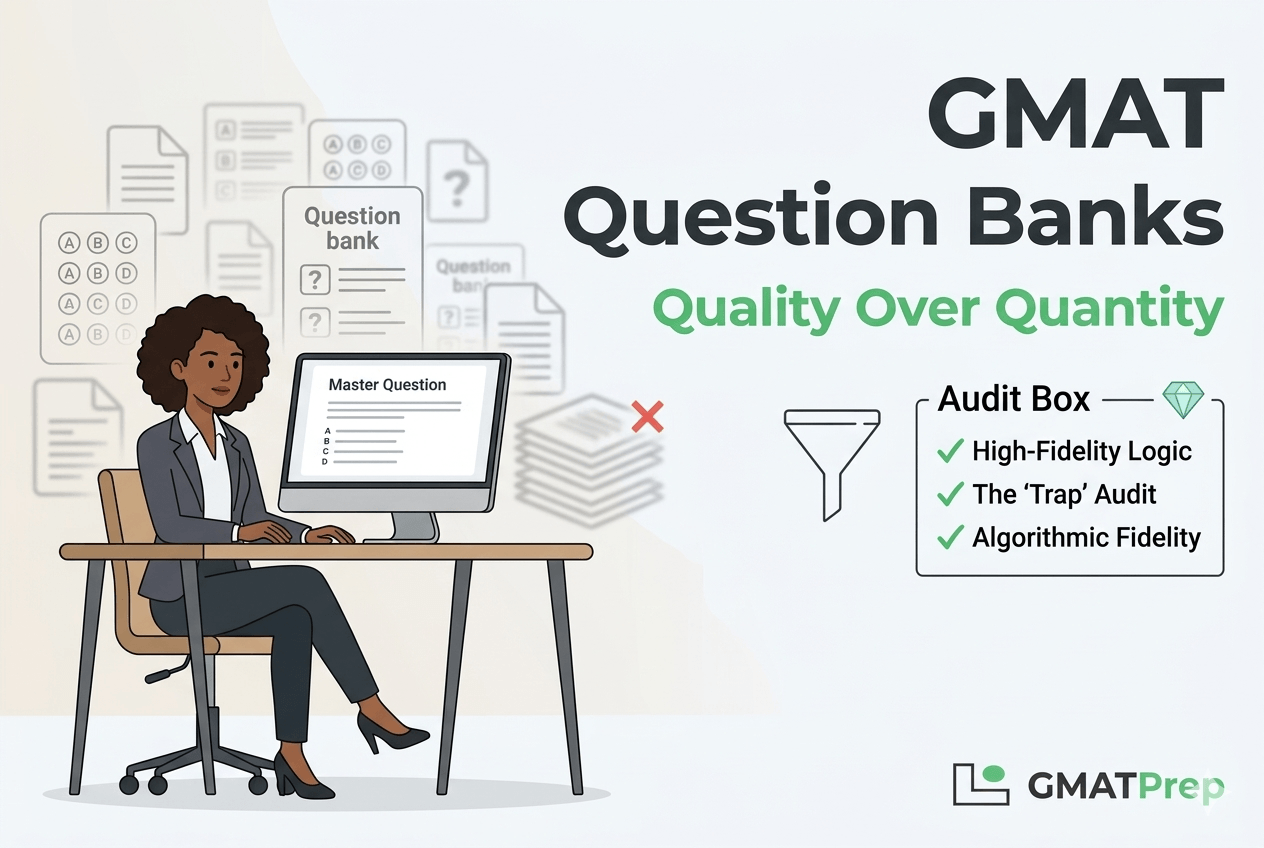
In the era of digital learning, access to information is no longer the problem; filtering it is. For a GMAT aspirant, the “Volume Trap” is one of the most dangerous hurdles to clear. It is easy to find “Mega-Folders” containing 5,000+ practice questions or “Question Banks” promising an endless supply of drills.
However, the GMAT Focus Edition is not a test of endurance or rote memorization. It is a test of precision, logic, and cognitive flexibility. In this high-stakes environment, GMAT question quality is the single most important variable in your preparation.
Solving 500 high-quality questions with deep analysis will almost always lead to a higher score than mindlessly clicking through 5,000 low-quality ones. This article explores why the “Quality Over Quantity” mantra is the backbone of elite GMAT scores and how to audit your GMAT prep materials.
1. The “Volume Trap”: Why More is Often Less
Many students begin their journey with the belief that the GMAT is like a university math or grammar exam—if they see enough “types” of questions, they will be prepared for anything.
The Reality: The GMAT algorithm is designed to punish “pattern matching.” If you rely on a practice question bank that uses repetitive, formulaic structures, you are training your brain to look for specific “set-ups” rather than the underlying logic. When the official exam presents a concept you know in a visual format you’ve never seen, your pattern-matching brain will panic.
The Problem with “Low-Fidelity” Questions
Low-quality questions often suffer from three fatal flaws:
- Hallucinated Logic: They test concepts in a way the GMAT never would (e.g., overly complex multi-step arithmetic instead of elegant logic).
- Binary Difficulty: They are either “Too Easy” (testing only one step) or “Impossible” (requiring outside knowledge not on the GMAT syllabus).
- Vague Constraints: They forget to mention crucial details (e.g., “x is a positive integer”), which leads to multiple “correct” answers or ambiguous logic.
2. The Anatomy of a High-Quality GMAT Question
What makes a question “GMAT-like”? High-fidelity GMAT prep materials mirror the official exam’s philosophy in three specific areas:
The “Logic First” Approach
A high-quality Quant question is rarely about the “Calculation.” It is about the “Inference.” For example, instead of asking you to calculate the square root of a massive number, a high-quality question will ask you to determine the properties of that number’s factors.
The “Trap of Plausibility”
In Verbal (Critical Reasoning and Reading Comprehension), low-quality banks often include “garbage” distractors—options that are obviously wrong. High-quality questions include 2–3 options that are “Plausible but Incorrect.” These distractors exploit common cognitive biases, such as the “Out of Scope” trap or the “Reverse Logic” trap.
Integrated Reasoning in Data Insights (DI)
With the Focus Edition, the Data Insights section is now a core component of your score. High-quality DI questions must integrate data from multiple sources (charts, tables, and text) simultaneously. Many low-quality banks simply offer “Math in a Chart,” failing to test the synthesis of information.
3. High-Quality vs. Low-Quality: A Comparison
| Feature | Low-Quality Question Bank | High-Quality Question Bank |
| Focus | Computational Complexity (Hard Math). | Logical Elegance (Smart Thinking). |
| Verbal | Tests “Grammar Rules” or “Opinion.” | Tests “Logical Structure” and “Evidence.” |
| Explanation | “A is right because B, C, and D are wrong.” | Explains the “Path of Logic” and the “Trap.” |
| Difficulty | Based on “How long it takes to solve.” | Based on “How many logic gaps you must bridge.” |
| DI Section | Static graphs with simple look-ups. | Interdependent data requiring synthesis. |
4. The “Deep-Dive” Method: Quality in Execution
Having the right practice question bank is only half the battle; how you use it determines your ROI. Top scorers use the “Deep-Dive” method.
Quality Review > Quantity Solving
Instead of doing 30 questions in an hour, do 10. Then, spend the next 40 minutes performing a forensic audit of those 10 questions.
- For the ones you got right: Did you solve it the “long way” or the “GMAT way”? Is there a logic shortcut you missed?
- For the ones you got wrong: Why was the wrong answer tempting? What specific word in the prompt did you overlook?
The “Second Chance” Rule
Never look at the explanation immediately. If you get a question wrong, wait four hours and try to solve it again from scratch. If you can solve it the second time, your issue isn’t “Knowledge”—it’s “Execution” or “Pacing.”
5. Auditing Your GMAT Prep Materials
Before you invest another hour into your current study routine, put your materials through this 3-point audit:
Audit 1: The “Why” Test
Look at the explanations provided by your question bank. If the explanation says, “This is wrong because it doesn’t sound right,” or “This is the answer because of a complex formula,” the quality is likely low. High-quality materials will always point to a specific logical constraint within the text.
Audit 2: The “DI Integration” Test
Go to your Data Insights section. Are the questions asking you to simply find a number on a graph? Or are they asking you to use that number to evaluate a statement in a separate tab? If it’s the former, you aren’t being prepared for the 705+ level.
Audit 3: The “Trap” Test
Do you find yourself saying, “I see why both A and B could be right”? In a high-quality bank, once you see the logic, the wrong answer becomes objectively wrong. If the “correct” answer feels like a matter of opinion, the question bank is flawed.
6. Where to Find High-Quality Questions
The gold standard will always be official materials, but official questions are a finite resource. You must supplement them with high-fidelity unofficial sources.
- The Official Guide (OG): Essential for understanding the “Tone” of the GMAT.
- GMATPrep Diagnostic Quizzes: Our Quiz page is designed to mimic the exact logical constraints of the Focus Edition, helping you identify gaps before you waste official mocks.
- Adaptive Simulations: A high-quality mock should not just give you a score; it should give you a “Pacing Map.” Check our Mock test page for simulations that use a calibrated IRT algorithm to mirror the real testing experience.
7. The Psychological Benefit of Quality
There is a hidden cost to low-quality questions: Discouragement. When you get a “bad” question wrong because the logic was faulty, you lose confidence in your own reasoning. You start to doubt yourself on the real exam. Conversely, when you master high-quality questions, you build “Logical Intuition.” You start to see the “Matrix” of the test—you can predict the traps before you even finish reading the prompt.
Conclusion: Build a Foundation, Not a Library
Your goal is to walk into the test center with a sharp, analytical mind, not a library of memorized questions. Every time you choose to do “one more set” instead of “one deep review,” you are prioritizing quantity over the result.
Choose GMAT prep materials that challenge your thinking, not your patience. Focus on the GMAT question quality, maintain a rigorous error log, and remember: The GMAT is a game of skill. In any game, practicing the wrong moves 10,000 times only makes you a master of losing.
Ready to test your logical precision?
Don’t settle for “Volume” when you can have “Value.” Visit our Quiz page to take a targeted diagnostic and see if your logic holds up under GMAT-style constraints. If you’re ready for a full-scale simulation, head to our Mock test page to experience the closest thing to the official Focus Edition algorithm available today.
Leave a Reply