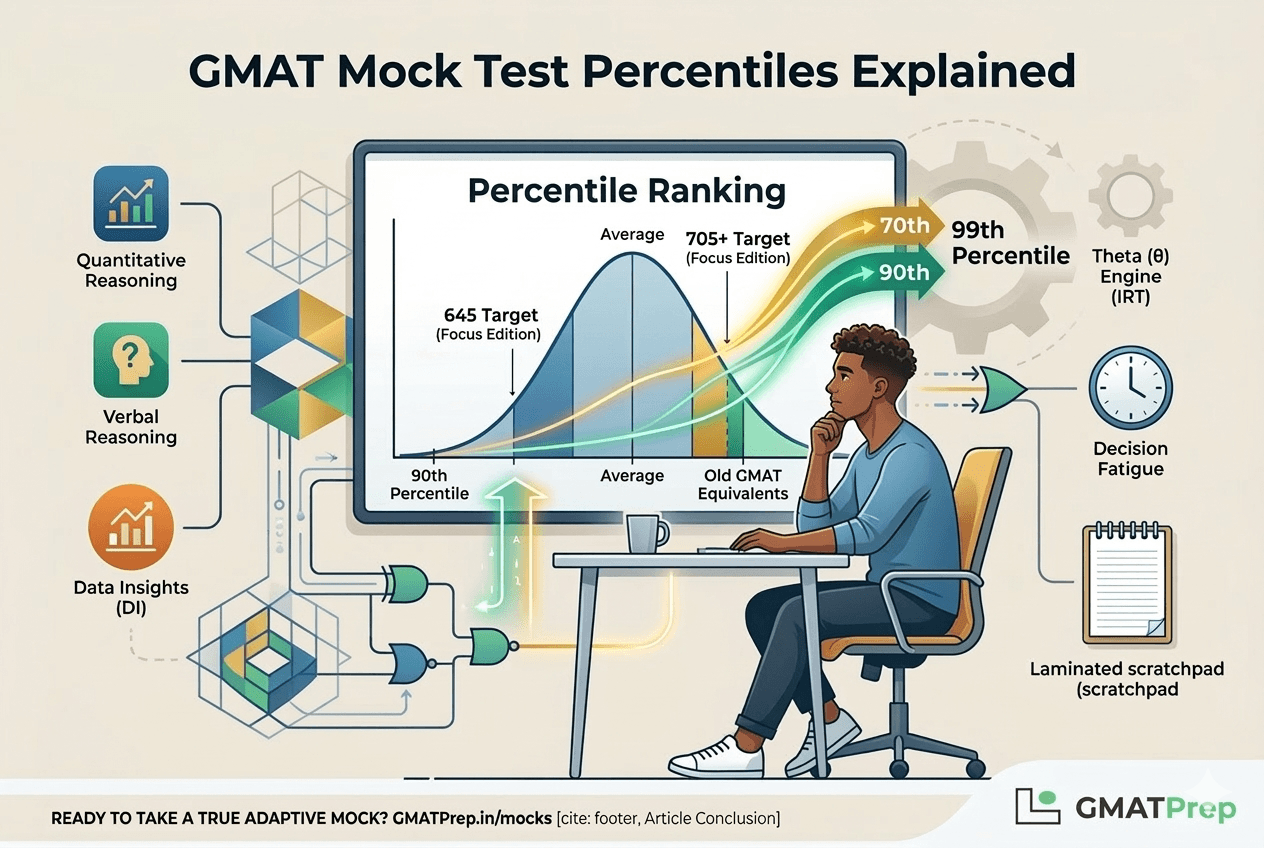
When you finish a GMAT mock test, your eyes likely dart immediately to that three-digit number—perhaps a 645 or a 705. But right next to it, usually in smaller font, is another number: your GMAT percentile. For many aspirants, this second number is a source of profound confusion. “How can a 705 be the 99th percentile now, when it used to be much lower?” or “Why is my 80th percentile in Quant harder to achieve than my 80th percentile in Verbal?”
In the new GMAT Focus Edition, understanding GMAT scoring and percentile ranking is more critical than ever. Percentiles have shifted dramatically, and interpreting them correctly is the difference between a panicked study session and a strategic, data-driven preparation plan.
This guide will explain exactly what your mock test percentiles mean, how they differ from raw scores, and how top business schools use them to evaluate your candidacy.
1. What Exactly is a GMAT Percentile?
At its core, a percentile is a relative measure. While your raw score (205–805) tells you how you performed against the exam’s internal logic, your percentile tells you how you performed relative to other test-takers.
If you receive a 90th GMAT percentile, it means you scored higher than 90% of the people who took the exam over the last three years. It is a “ranking” rather than a “grade.” In GMAT verbal practice or Quant drills, you might get 80% of questions right, but if everyone else gets 90% right, your percentile will be low.
The Difference Between Percentage and Percentile
- Percentage: The number of questions you got correct (e.g., 18 out of 21). On an adaptive test like the GMAT, this is almost irrelevant because the computer adjusts difficulty to keep you at a ~50-60% accuracy rate.
- Percentile: Your rank in the pool of test-takers. This is what admissions committees use to compare a candidate from a background in engineering with one from a background in the arts.
2. The Great Shift: GMAT Focus Edition vs. The Old GMAT
One of the biggest hurdles in interpreting GMAT mock test results today is the legacy of the old 200–800 scale. On the old GMAT, a 700 was the “gold standard” but represented roughly the 88th percentile.
On the GMAT Focus Edition:
- A 705 is now roughly the 99th percentile.
- A 645 is roughly equivalent to the old 700 (89th–90th percentile).
Because the Focus Edition has removed Sentence Correction and shifted the scoring algorithm to treat Data Insights as a core component, the “center” of the bell curve has shifted. If your mock score looks “lower” than what you expected based on older forum posts, check the percentile. You might actually be performing better than you think.
3. Breaking Down Sectional Percentiles
Your total percentile is an aggregate, but your sectional percentiles for Quant, Verbal, and Data Insights tell a much more specific story about your “cognitive peak.”
Quantitative Reasoning Percentiles
Traditionally, Quant percentiles have been highly competitive. Because so many test-takers (especially those from STEM backgrounds) score near the top, a raw score of 85 or 86 might only put you in the 70th or 80th percentile. To reach the 90th+ percentile in Quant, you must master the “Logic Traps” and the “Engine Audit” strategies.
Verbal Reasoning Percentiles
Verbal percentiles tend to be “spaced out” more. Because the “Verbal Ceiling” is harder to hit, a high raw score in Verbal often yields a much higher percentile than a similar raw score in Quant. This is why many successful 705+ scorers use a “Verbal-Heavy” strategy to boost their overall ranking.
Data Insights (DI) Percentiles
As the newest section, DI percentiles are still stabilizing. However, because DI requires a hybrid of math and logic, it acts as a “filter” for elite scores. A high DI percentile is often a strong indicator of “Business Readiness,” which is exactly what admissions officers are looking for.
4. How Mock Tests Estimate Your Percentile
When you take an adaptive mock on our Mock test page, the platform doesn’t just count your right and wrong answers. It uses Item Response Theory (IRT) to estimate your “Theta” θ.
The “Theta” Game
The algorithm assigns every question a difficulty parameter.
- If you get a high-difficulty question right, your Theta (and thus your percentile) jumps.
- If you miss an easy question, the algorithm “punishes” your percentile more severely because it suggests your “floor” is lower than expected.
Mock tests provide a “Percentile Range.” Because a single mock is a snapshot, your “True Percentile” is likely within +/- 5 points of your mock result. This is why we advocate for a structured mock schedule to track the trend of your percentiles rather than obsessing over a single data point.
5. Why Percentiles Matter for MBA Applications
Admissions committees (AdComs) don’t just look at your total score; they look at the “balance” of your percentiles.
The “Balanced Profile”
An applicant with an 80th percentile in both Quant and Verbal is often viewed more favorably than an applicant with a 99th in Quant but a 40th in Verbal. The latter suggests a “Cognitive Gap” that might make the heavy reading load of an MBA program difficult.
Comparing Global Candidates
Business schools receive applications from around the world. Since GPA standards vary wildly between countries and universities, the GMAT percentile ranking is the only “common denominator” that allows a fair comparison between a student from Mumbai, a student from London, and a student from New York.
6. Common Percentile Pitfalls to Avoid
1. Comparing “Mocks” to “Official” Directly
Third-party mocks are often designed to be slightly harder than the official exam—a concept known as “Training at Altitude.” If your mock percentile is slightly lower than your official target, don’t panic. Use the Score calculator to see how your raw scores translate across different scales.
2. Ignoring the “Decision Fatigue” Factor
If your percentile drops in the final section of your mock, it isn’t a “Concept Gap”—it’s a stamina issue. Percentiles in mocks often reflect your ability to maintain focus over 2 hours and 15 minutes. If you find your Verbal percentile is high in untimed drills but low in full mocks, your “State-Dependent Learning” needs work.
7. How to Improve Your GMAT Percentile
Moving from the 70th to the 90th percentile isn’t about learning “more” math or grammar; it’s about refining your test-taking logic.
- The 1:2 Review Rule: For every hour of testing, spend two hours analyzing your logic. Why did you fall for that “Logic Trap”?.
- The 90-Second Rule: To protect your percentile, you must protect your time. Spending 4 minutes on a single Quant question is a “Percentile Killer” because it guarantees you will rush—and miss—easier questions later.
- Mastering the Review Feature: In the Focus Edition, you can change 3 answers. Use this to fix “Careless Errors” that would otherwise tank your Theta estimate.
Conclusion: Use the Data to Your Advantage
Your GMAT percentile is not a judgment of your intelligence; it is a measurement of your preparation efficiency. By understanding that a 645 is the new 700 and that Data Insights is the new “filter” for elite programs, you can approach your GMAT practice with a much clearer head.
Don’t let the numbers discourage you. Use them as a diagnostic map. If your percentile is low in one area, that is simply the algorithm showing you exactly where your “Score Peak” is currently capped.
Ready to see where you rank? Head to our Mock test page to take a full-length, adaptive mock and get your forensic percentile report. Once you have your data, use our Score calculator to project your potential and start your journey to the 99th percentile today.
Leave a Reply