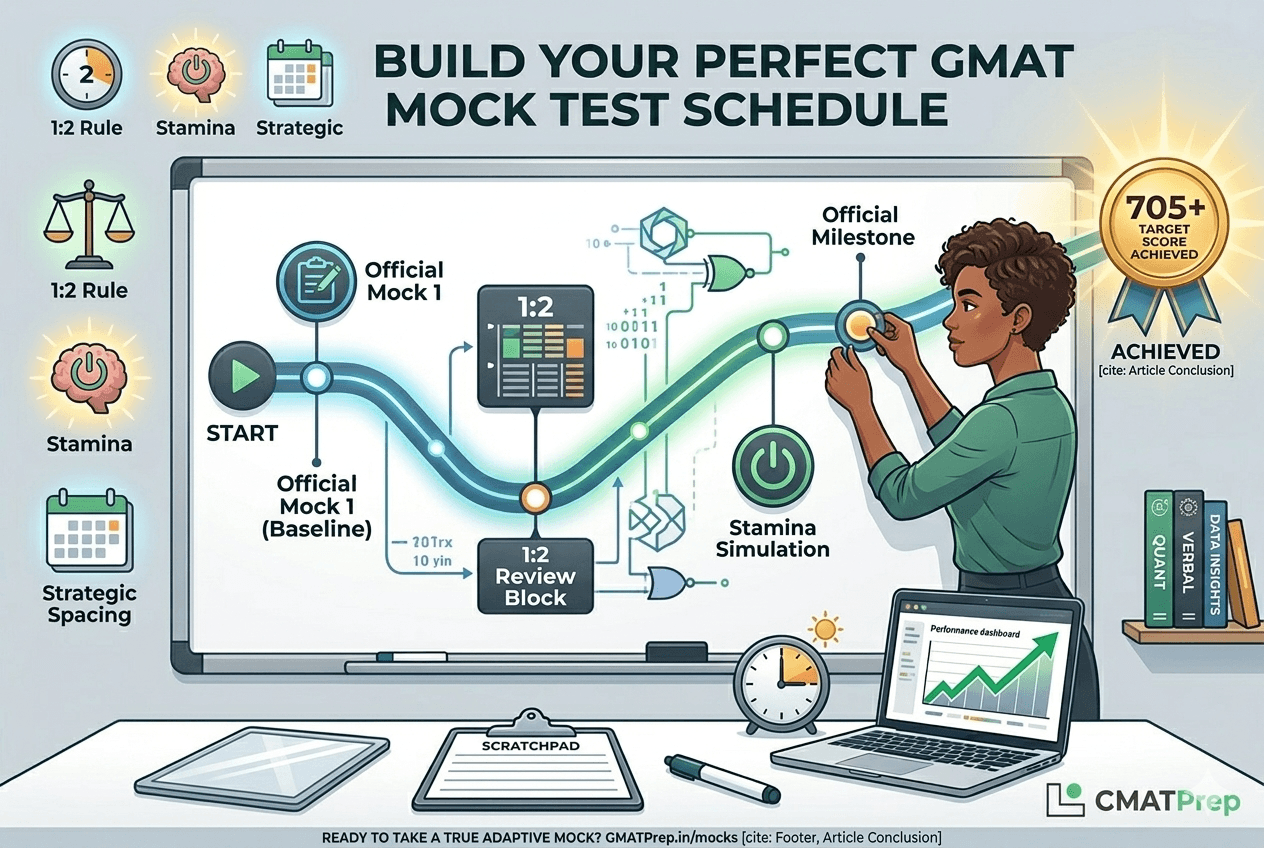
One of the most common pitfalls in GMAT preparation isn’t a lack of effort—it’s a “Test Frequency Frenzy”. Many aspirants believe that taking a mock test every other day will somehow force their score to climb. In reality, this approach leads to burnout and reinforces bad habits rather than fixing them.
A truly effective GMAT mock schedule isn’t just a list of dates on a practice test calendar; it is a strategic roadmap that balances diagnostic testing, concept building, and full-dress simulation. To improve GMAT mock score outcomes, you must give your brain the time to bridge the gap between “knowing the math” and “applying the logic” under pressure.
In this guide, we’ll break down how to structure your GMAT study schedule into distinct phases, ensuring every mock you take provides maximum ROI.
The Golden Rules of Mock Scheduling
Before you mark your calendar, you must adhere to three foundational principles that separate top-scorers from those who plateau.
1. Respect the 1:2 Review Rule
For every hour you spend taking a test, you must spend at least two hours reviewing it. If a GMAT Focus Edition mock takes roughly 2 hours and 15 minutes, your review session should be a forensic 4.5-hour deep dive. Scheduling mocks too close together makes it impossible to perform this level of analysis, leading to the “Take and Forget” Syndrome.
2. Space Mocks for Concept Building
Mocks are thermometers, not medicines. They tell you your “temperature” (score), but they don’t “cure” your weaknesses. You should typically space your mocks 10–14 days apart during the early and middle phases of your prep. This window provides enough time to fix the “Concept Gaps” and “Logic Traps” identified in your previous attempt.
3. Match Your Biological Peak
Your practice test calendar should align with your actual exam appointment. Thanks to “State-Dependent Learning,” your brain performs best when it is conditioned to be alert at the specific time of your test. If your exam is at 8:00 AM, don’t schedule your mocks for 9:00 PM when you are battling “Decision Fatigue”.
Phase 1: The Diagnostic Phase (Weeks 1–2)
The goal here is to establish your “Theta” ($\theta$) baseline—the starting point for the GMAT algorithm to track your progress.
- Week 1, Day 1: Take Official Mock 1 from GMAC to find your unvarnished baseline.
- Week 1, Day 2–4: Perform a deep-dive audit. Categorize mistakes into Silly Mistakes, Concept Gaps, or Pacing Issues.
- Week 2: Focus exclusively on foundational repair. Do not take another mock. Use targeted resources to patch the biggest holes in your Quant or Verbal knowledge.
Phase 2: The Development Phase (Weeks 3–6)
In this phase of your GMAT study schedule, you transition to using adaptive GMAT mocks from third-party providers. This preserves your limited official mocks for the final countdown while giving you advanced analytics like “Stamina Drop-off” reports.
Sample 8-Week Timeline (Development)
- Week 3: Take Third-Party Mock #1. Use this to practice your “Keep or Kill” mindset and the 90-second rule.
- Week 4: Review and Drill. If your Data Insights score is low, treat it as a core section, not an elective.
- Week 5: Take Third-Party Mock #2. Focus on “Strategic Guessing”—knowing when to walk away from a “Hero” question to protect your pacing.
- Week 6: Analyze your “Time Per Question.” Refine your Verbal structural roadmaps and Quant logic.
Phase 3: The Simulation Phase (Weeks 7–10)
Now, the focus shifts from content to “Test Simulation”. You are training your body and mind to handle the physical rigors of the test center.
- Frequency: One mock every 7 days.
- The Environment: Take these mocks in a quiet room, using a laminated scratchpad, and adhering to the strict 10-minute break.
- Week 7: Third-Party Mock #3. Focus on maintaining stamina through the final section.
- Week 8: Third-Party Mock #4. This is your “Training at Altitude.” If this mock feels harder than the real thing, it’s building your mental muscle.
- Week 9: Review all previous error logs. Look for “Trends, not Outliers”. Don’t let “Post-Mock Blues” from one bad score dictate your entire strategy.
Phase 4: The Final Polish (Weeks 11–12)
In the final fortnight, you return to the “Gold Standard” official mocks to calibrate your brain to the official GMAC voice.
- 10 Days Before Exam: Official Mock 2. This is your most accurate score predictor.
- 5 Days Before Exam: Light review only. Do a “Strategic Walkthrough” of 50 hard questions—identifying the path to solution without actually solving them.
- 48 Hours Before Exam: No more mocks. Your brain needs to recover from “Decision Fatigue”.
- 24 Hours Before Exam: Total rest.
Comparison: 8-Week vs. 12-Week Mock Calendars
| Week | 8-Week “Sprint” Schedule | 12-Week “Deep Dive” Schedule |
| Week 1 | Official Mock 1 (Diagnostic) | Official Mock 1 (Diagnostic) |
| Week 2 | Content Intensive | Content Intensive |
| Week 3 | Third-Party Mock #1 | Content Intensive |
| Week 4 | Third-Party Mock #2 | Third-Party Mock #1 |
| Week 5 | Third-Party Mock #3 | Content/Drill Week |
| Week 6 | Official Mock 2 (Final) | Third-Party Mock #2 |
| Week 7 | Strategy/Refinement | Strategy/Refinement |
| Week 8 | Actual GMAT Exam | Third-Party Mock #3 |
| Week 10 | — | Third-Party Mock #4 |
| Week 12 | — | Actual GMAT Exam |
Why This Schedule Works
This practice test calendar is designed to combat the “Comfort Zone Trap”. By varying your mock sources and strictly simulating test conditions, you prevent yourself from becoming a “practice champion” who freezes on the real test day.
Furthermore, by integrating the “1:2 Review Rule,” you ensure that you are actually learning from your mistakes. Remember, a mock test is only as valuable as the review that follows it. If you skip the review, you are simply practicing how to fail.
Conclusion: Stick to the Plan
Building a GMAT mock schedule is an exercise in discipline. There will be days when you feel the urge to take an extra mock to “prove” your score has gone up after a good study session. Resist that urge. Stick to the spacing, respect your biological peaks, and never compromise on the quality of your review.
Your target score of 705+ is not the result of how many tests you take; it’s the result of how many mistakes you fix.Ready to start your first phase? Head to our Mock test page to take your baseline adaptive mock and get the analytics you need to build your custom timeline. If you need more practice problems to fill the gaps between your tests, explore our full library on the Resources page.
Leave a Reply