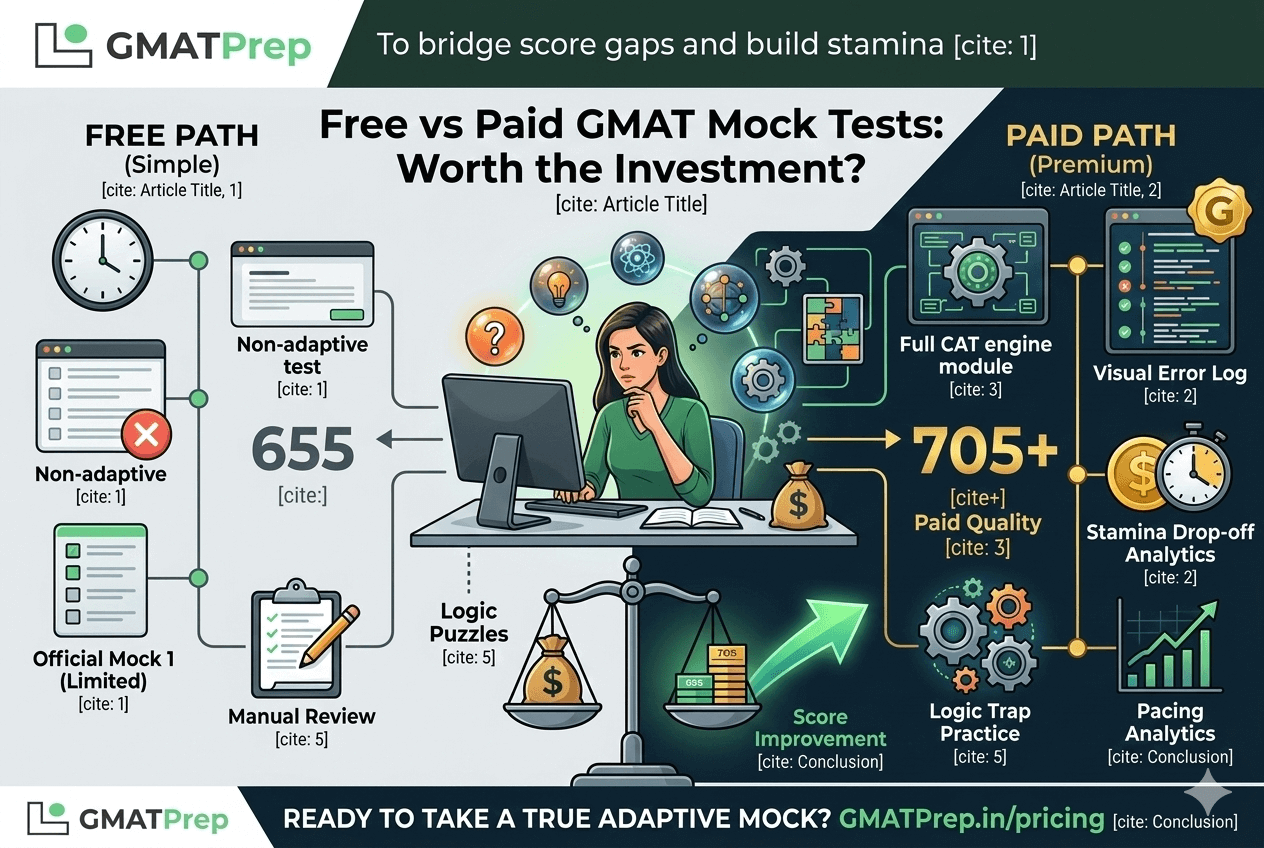
Every GMAT aspirant eventually reaches a crossroads: should you rely on the handful of free resources available, or is it time to open your wallet for premium practice materials? With the GMAT Focus Edition’s high stakes and the push for a 705+ score, the decision between free vs paid GMAT mocks isn’t just about “saving money”—it’s about maximizing your return on time.
To improve GMAT mock score results, you need a balance of algorithmic accuracy and deep diagnostic insights. While free tests offer a low-stakes starting point, paid mocks often provide the surgical precision required to break through a score plateau.
In this guide, we’ll break down the pros and cons of both, analyze GMAT mock test pricing, and help you determine which offers the best value mocks for your specific journey.
1. The Power of Free: The Starting Line
Almost every successful student begins their journey with free resources. They are essential for establishing a baseline without an immediate financial commitment.
The “Gold Standard” Free Mocks
The most important free resource is the Official GMAT Mock 1 provided by GMAC. Because it uses the actual proprietary scoring algorithm, it provides the most accurate initial “Theta” ($\theta$) estimate of your ability.
- Best Use: Use this on Day 1 of your 30-day action plan to establish your unvarnished baseline.
- The Limitation: These free official mocks are limited in number and lack the deep “Visual Error Logs” found in premium third-party platforms.
Third-Party Free Samplers
Many prep companies offer one free mock to entice students.
- The Benefit: These are great for practicing “Keep or Kill” mindsets and the 90-second rule without using up your limited supply of official exams.
- The Risk: Be wary of using sub-par, non-adaptive materials. If a free mock isn’t using Computer Adaptive Technology (CAT), the score it gives you may be significantly inflated or deflated.
2. Why Pay? The “Analytics Gap”
If free mocks provide the score, paid mocks provide the reason for the score. To increase GMAT score outcomes, you need to look beyond the final three-digit number.
Visual Error Logs and Stamina Analytics
Official mocks are notoriously thin on data. They tell you which questions you missed but rarely show you why your performance dropped. Premium paid GMAT mocks offer advanced analytics that highlight:
- Stamina Drop-offs: Are you making more “careless” errors 30 minutes into the Verbal section?.
- Topic-Specific Weakness: Do you have a “Concept Gap” in Number Properties or a “Logic Trap” issue in Critical Reasoning?.
- Pacing Analytics: Are you falling into the “Hero Complex” by over-investing in hard questions?.
Facilitating the 1:2 Review Rule
To truly improve, you must spend two hours reviewing for every one hour of testing—the 1:2 Review Rule. Paid platforms are designed to make this forensic review easier by categorizing mistakes into “Concept Gaps,” “Silly Mistakes,” or “Pacing Issues” automatically.
3. Comparing Algorithmic Integrity
The GMAT is an item-adaptive test. Every answer you submit informs the computer’s estimate of your ability.
The Difficulty and Discrimination Factor
Premium mocks invest heavily in replicating the official parameters:
- Difficulty (b): The level where you have a 50% chance of success.
- Discrimination (a): How well a question separates high-ability from low-ability students.
Using sub-par, non-adaptive free materials is a common mistake because they fail to simulate this “engine”. If you practice on a linear (non-adaptive) test, you aren’t training your brain for the “Verbal Ceiling” or the escalating difficulty of the Quant section.
4. Content Freshness: The Focus Edition Shift
With the transition to the GMAT Focus Edition, the best value mocks must include Data Insights (DI) as a permanent, scored core section.
Many “free” mocks found online are outdated versions of the old GMAT (10th Edition).
- The Mistake: Treating Data Insights like an elective or practicing with Sentence Correction questions that are no longer on the exam.
- The Paid Advantage: Premium mocks are updated to mirror the Focus Edition exactly, ensuring you aren’t wasting mental energy on irrelevant content.
5. ROI Analysis: Is the Investment Worth It?
When considering GMAT mock test pricing, don’t just look at the sticker price; look at the cost of retaking the actual $275+ exam.
| Feature | Free Mocks | Paid Mocks |
| Algorithmic Accuracy | High (Official) / Variable (Others) | High (Adaptive CAT) |
| Diagnostic Analytics | Minimal | Advanced Visual Error Logs |
| Stamina Building | Limited Volume | High Volume for Simulation |
| Review Support | Self-Categorization Required | Automated Error Categorization |
| Pacing Tools | Basic Timer | Question-by-Question Analytics |
The Verdict: If you are aiming for a 705+ score, relying solely on free mocks is a high-risk strategy. Premium mocks act as “training at altitude,” preparing you for the decision fatigue and logical traps of the real test center.
6. The Hybrid Strategy: The Most Efficient Path
You don’t have to choose one or the other. Most top-scorers use a hybrid approach to maximize their GMAT practice timing and budget.
- Phase 1 (Baseline): Use the free Official Mock 1 to find your “Theta”.
- Phase 2 (Development): Purchase a pack of adaptive third-party mocks. Use these to identify your “Stamina Drop-offs” and “Concept Gaps”.
- Phase 3 (Drills): Based on mock analytics, use Quiz pages for targeted sub-topic practice.
- Phase 4 (Final Calibration): Use Official Mock 2 (or other paid official mocks) in the final 5 days to calibrate your ear to the “Official GMAT Voice”.
Conclusion: Don’t Let “Free” Be Your Ceiling
In the world of GMAT prep, you often get what you pay for. While free mocks are excellent for your initial diagnosis, they rarely provide the data-driven roadmap needed to bridge a 50-point score gap.
Investing in high-quality, adaptive practice is an investment in your confidence and your future MBA applications. By avoiding common mistakes—like using non-adaptive materials or skipping the 1:2 review—you ensure every dollar spent on your score improvement plan moves you closer to that 705+ goal.
Ready to see the difference data makes? Visit our Mock test page to explore our adaptive testing options and our Pricing page to find the plan that fits your goals. Don’t just take tests; master the algorithm.
Leave a Reply