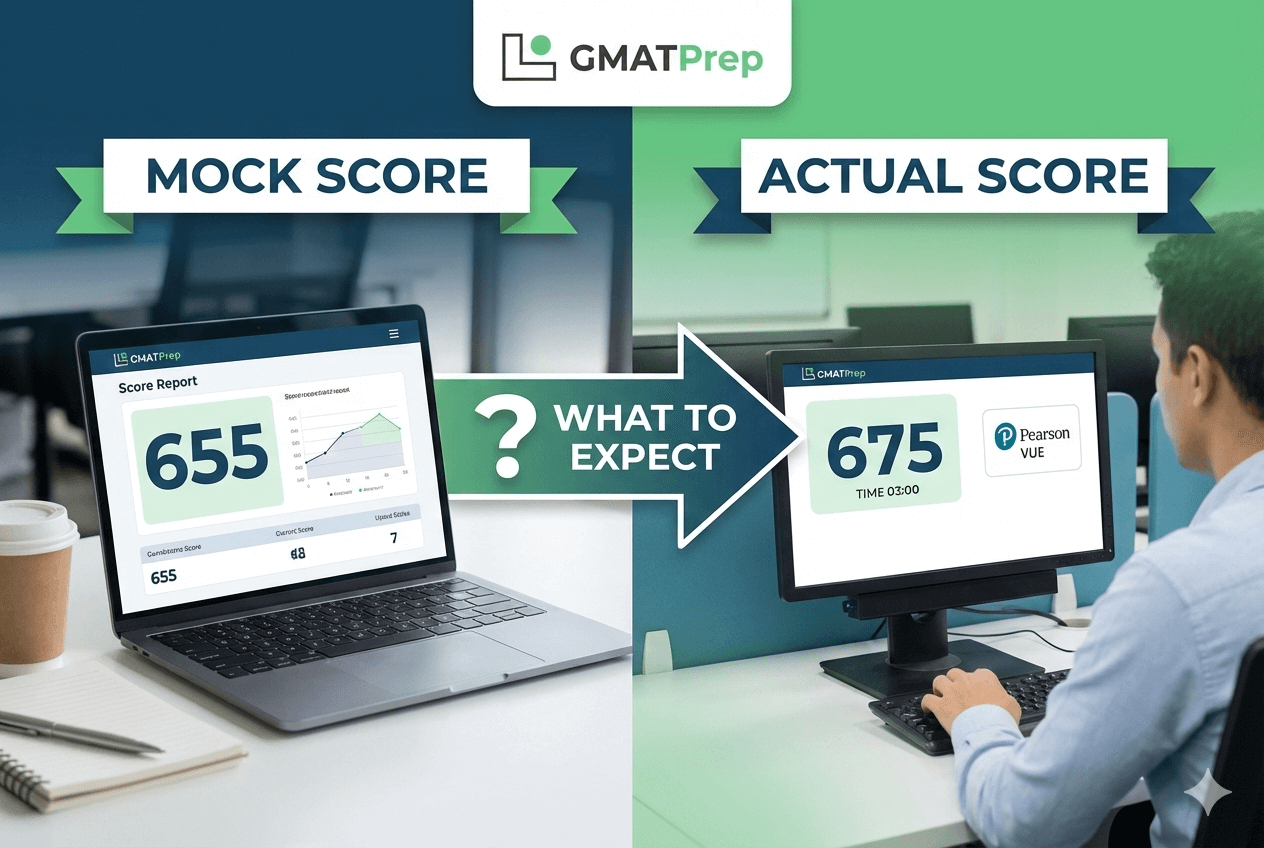
One of the most common questions echoing through GMAT forums and study groups is: “I just scored a 645 on my mock; what will I get on the actual exam?” The relationship between GMAT mock vs actual scores is the source of significant anxiety for test-takers. For some, the mock score is a perfect crystal ball. For others, the actual exam day brings a surprising 50-point swing—either a triumphant surge or a disappointing dip.
Understanding mock test accuracy is not just about managing expectations; it is about refining your strategy. In this analysis, we will deconstruct the “prediction gap,” explore why variances occur, and explain how to use your practice results for an accurate GMAT score prediction.
The Reality of the “Prediction Gap”
In a perfect world, a mock test would be an identical twin to the actual exam. However, the GMAT is a psychometric instrument designed to measure “ability” under specific constraints. While the algorithm is consistent, the human element—you—is a variable.
Statistically, most students see a variance of +/- 30 to 40 points between their final few mocks and their actual GMAT Focus Edition score. If your mock scores are consistently in the 655-665 range, a “successful” actual score is anything from 645 to 685.
Why the GMAT Focus Edition Changed the Game
Since the transition to the Focus Edition, the scoring scale has shifted (205–805). Because the new scale is more “congested” in the higher percentiles, a small change in raw performance can lead to a more noticeable shift in the total score compared to the old 800-point scale. This makes mock test accuracy more critical than ever.
Why Mocks Sometimes “Lie”: Factors Influencing Variance
When analyzing GMAT mock vs actual performance, we have to look at the factors that practice tests often fail to replicate.
1. The “Adrenaline Factor” (Test Center Anxiety)
You can replicate the questions, but it is hard to replicate the silence of a Pearson VUE test center, the presence of a proctor, and the “weight” of the $275 exam fee.
- The Positive Swing: Some students thrive under pressure, finding a level of focus they never achieved at home.
- The Negative Swing: For others, anxiety leads to “paralysis by analysis,” causing them to fall behind on the clock.
2. Environmental Variables
Taking a mock in your bedroom with a familiar keyboard, your favorite chair, and a coffee nearby is a “low-friction” environment. On test day, you might deal with:
- An unfamiliar erasable notepad and marker.
- The sound of other students typing or coughing.
- The biometric check-in process which can be mentally draining before you even see the first question.
3. The Quality of the Mock Algorithm
Not all mocks are created equal. A high-quality GMAT mock online must use a sophisticated Computer Adaptive Test (CAT) engine. If the mock’s algorithm is too “generous”—meaning it doesn’t penalize streaks of wrong answers correctly—your score will be inflated. Conversely, if it uses a linear difficulty curve, it won’t prepare you for the “pressure cooker” effect of getting five hard questions in a row.
Evaluating the Sources: Which Mocks are Most Accurate?
To get a reliable GMAT score prediction, you need to know which data points to trust.
Official Mocks (MBA.com)
The official mocks are the only ones that use retired GMAT questions and the exact proprietary algorithm.
- Predictive Power: Very High.
- The Caveat: Because students often use these tests multiple times, “score inflation” can occur if you recognize even one or two questions from a previous attempt or a forum.
GMATPrep.in Adaptive Mocks
Our platform is engineered to mirror the “Exact Exam Level” difficulty of the Focus Edition. We focus specifically on the mock test accuracy of the Data Insights (DI) and Verbal sections, which are often where third-party providers struggle.
- Predictive Power: High.
- The Advantage: Our mocks provide deep-dive analytics that official mocks lack. By identifying your “stamina drop-off” points, we help you close the gap between your mock and actual potential. You can start your journey on our Mock Test Page.
How to Increase the Accuracy of Your Mock Results
If you want your GMAT mock vs actual comparison to be valid, you must treat your practice sessions as a dress rehearsal, not a casual rehearsal.
1. Replicate Test-Day Timing
The GMAT Focus Edition allows you to choose your section order. If you plan to take Quant-DI-Verbal on test day, do exactly that in every mock. Changing your order on the day of the exam is a recipe for a 30-point drop.
2. Use the Right Tools
Stop using a pencil and paper for your scratchwork. Buy the official GMAT scratchpad (or a laminated equivalent) and a fine-point permanent marker. Getting used to the “feel” of the marker is a small detail that prevents frustration during the actual exam.
3. Take the Breaks
The GMAT provides an optional 10-minute break. Use it in your mocks. Practice getting up, stretching, and having a small, high-protein snack. This builds the “mental reset” habit you’ll need during the actual test.
The “Standard Deviation” of Performance
Even with perfect preparation, why do scores still fluctuate? It often comes down to the “Question Mix.”
The GMAT pulls from a massive bank of questions. You might be a “Number Properties” expert but struggle with “Rates and Work.” If your actual exam happens to pull 4 questions from your weak areas, your score will naturally dip.
This isn’t a failure of your GMAT score prediction; it’s simply the statistical variance of a 64-question exam. To mitigate this, you shouldn’t rely on the score of a single mock. Look at the average of your last three mocks. This average is almost always within 10-15 points of your actual ability.
Using Analytics for Better Prediction
A score is just a number; analytics are a roadmap. When reviewing your GMATPrep.in mocks, look for these three red flags that suggest your score might be fragile:
- The “Lucky Guess” Factor: Did your score go up because you guessed correctly on three 700-level questions at the end? If so, that score is inflated.
- The “Silly Mistake” Factor: Are you consistently missing “Easy” questions? On the actual exam, the adaptive algorithm will punish these misses severely, leading to a score much lower than your mocks suggest.
- The DI Exhaustion: The Data Insights section requires intense focus. If your DI score is consistently 5 points lower than your Quant score, it suggests a stamina issue that will be magnified by test-day nerves.
Conclusion: Setting Realistic Expectations
So, what should you expect?
If your average score across your last three high-quality, adaptive mocks is a 655, you should walk into the test center expecting a range of 635 to 675.
The goal of your preparation shouldn’t be to hit a “high score” once. The goal is to raise your “floor”—the score you get on your worst day. When your “worst day” score is at your target level, you are ready for the actual exam.
Ready to get an accurate read on your current level? Visit our Mock Test Page to take a Focus Edition adaptive exam. Use our analytics to bridge the gap between your GMAT mock vs actual performance and walk into the test center with the confidence of a 705+ candidate.
Leave a Reply