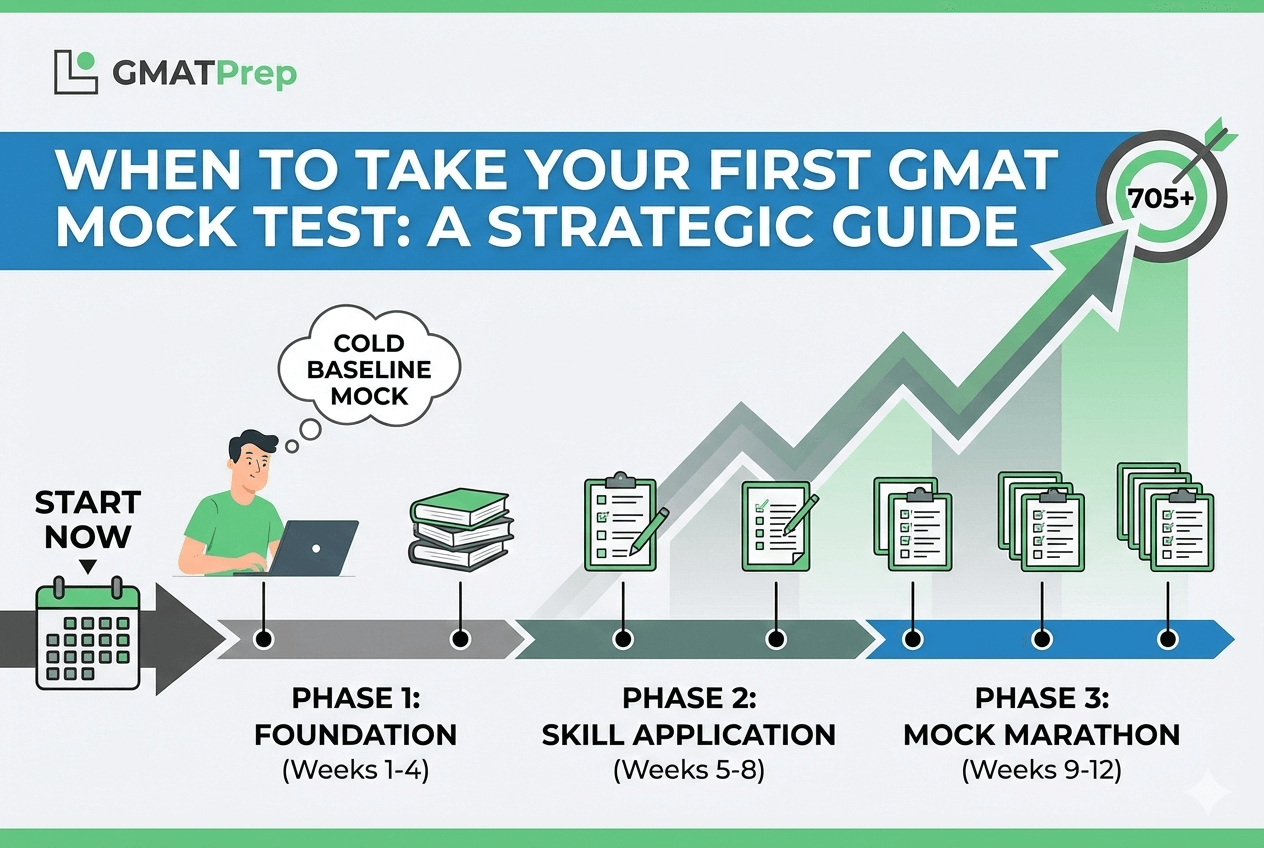
One of the most paralyzing decisions in the early stages of the GMAT journey is deciding exactly when to take GMAT mock exams. Should you jump in on Day 1 to see where you stand, or should you wait until you’ve mastered the difference between Number Properties and Sentence Correction?
The answer isn’t just about a date on the calendar; it’s about where you are in your GMAT preparation timeline. Taking a mock too early can be a blow to your confidence, but taking it too late can lead to a wasted study plan that ignores your actual weaknesses. In this guide, we will break down the strategic timing of your first mock test and how to integrate practice exams into a high-scoring study schedule.
The Philosophy of the “Cold” Baseline Mock
In the world of GMAT prep, a “Cold Mock” is a practice exam taken with zero prior preparation. Many students avoid this because they “know they are going to do poorly.” While that might be true, it is exactly why you should do it.
Why You Should Take Your First Mock on Day 1
Taking your first mock test immediately serves three critical purposes in your GMAT preparation timeline:
- Defining the Gap: If your goal is a 705 but your cold baseline is a 505, you now know you have a 200-point mountain to climb. This dictates whether you need a 3-month or a 6-month study plan.
- Identifying Natural Strengths: You might discover that despite not looking at a math problem in five years, your Quant score is surprisingly resilient, while your Verbal is where the “real work” lies. This prevents you from wasting weeks on topics you already intuitively understand.
- Understanding the “GMAT Logic”: The GMAT is not a math or English test; it is a reasoning test. Experiencing the adaptive nature of the exam firsthand is more valuable than reading ten articles about it.
The Risks of Waiting Too Long
A common mistake is the “Mastery Trap”—the belief that you shouldn’t take a mock until you have “finished the syllabus.”
If you wait two months to take your first mock test, you risk discovering that your “study sessions” haven’t translated into “test-taking ability.” You might know all the grammar rules but find that you cannot apply them under the 2-minute-per-question pressure of the Verbal section. By the time you realize this, you may have already formed bad habits that are hard to break.
Structuring Your GMAT Preparation Timeline
To reach peak performance, your study plan should be divided into distinct phases, with mocks acting as the milestones between them.
Phase 1: The Foundation (Weeks 1-4)
After your initial cold mock, your focus should be entirely on concepts. Don’t worry about speed yet. Focus on the “why” behind the answers. During this phase, you are not taking full mocks; you are doing untimed practice.
Phase 2: The Skill Application (Weeks 5-8)
Now that you know the rules, you need to learn how to play the game. This is when you start introducing timed sets. Halfway through this phase, you should take your second mock. This is usually where students see a “dip” or “plateau” in their scores as they try to apply new techniques instead of their old intuitions.
Phase 3: The Mock Marathon (Weeks 9-12)
In the final month, your frequency of when to take GMAT mock exams should increase. You should be taking one mock every 7 to 10 days, followed by an exhaustive 48-hour review.
Indicators You Are Ready for Your Next Mock
If you’ve already taken your first mock and are wondering when to schedule the next one, look for these signs:
- Consistent Accuracy in Practice: If you are hitting 80% accuracy in Medium-level questions and 60% in Hard-level questions during your daily study, it’s time to test that accuracy in a timed, adaptive environment.
- Plateaued Learning: If you feel like you are just “doing problems” without learning anything new, a mock test will provide the data needed to find your next area of growth.
- Timing Mastery: If you are consistently finishing your 10-question practice sets within 20 minutes, you are ready to see if that pacing holds up over a full 64-question exam.
How to Choose Which Mock to Take First
Not all mocks are created equal. For your very first attempt, the Official GMAT Focus Prep (Mock 1) from mba.com is often recommended because it uses retired official questions.
However, because official mocks are limited in number (only 6 exist), you don’t want to “burn” them all early. This is where high-quality third-party platforms become essential. Our Mock Test Page offers adaptive exams that mirror the official difficulty levels, allowing you to save the official mocks for the final weeks of your GMAT preparation timeline.
The “Bridge” Between Practice and Mocks
Many students find a massive discrepancy between their practice performance and their mock performance. This usually happens because practice is done in “bursts” (15 minutes here, 20 minutes there), whereas a mock requires 2 hours of sustained, high-level cognitive function.
To bridge this gap, you should treat your first mock test as an exercise in stamina. Don’t worry about the score; worry about whether you could maintain your focus until the very last question of the Data Insights section.
Common Pitfalls in Mock Timing
- The “Mock-a-Day” Madness: Taking mocks every day in the week leading up to the exam. This leads to burnout and prevents you from actually fixing the errors identified in the mock.
- Skipping the Review: If you spend 2 hours on a mock, you must spend at least 4 hours analyzing it. If you don’t have time to analyze, you don’t have time to take the mock.
- Ignoring the “Data Insights” Section: In the Focus Edition, DI is just as important as Quant and Verbal. Don’t wait until the end of your prep to start including DI in your mock attempts.
Conclusion: Your Next Step
So, when to take GMAT mock exams? The answer is now.
If you haven’t started, take a baseline. If you are in the middle of your prep, use a mock to recalibrate. The data provided by a mock test is the only way to ensure your GMAT preparation timeline is actually moving toward your target score.
Stop guessing and start measuring. Head over to our Study Plan Page to see how to integrate our adaptive exams into your schedule, or dive straight into your first attempt on our Mock Test Page.
Your 705+ score isn’t a matter of luck; it’s a matter of timing.
Leave a Reply