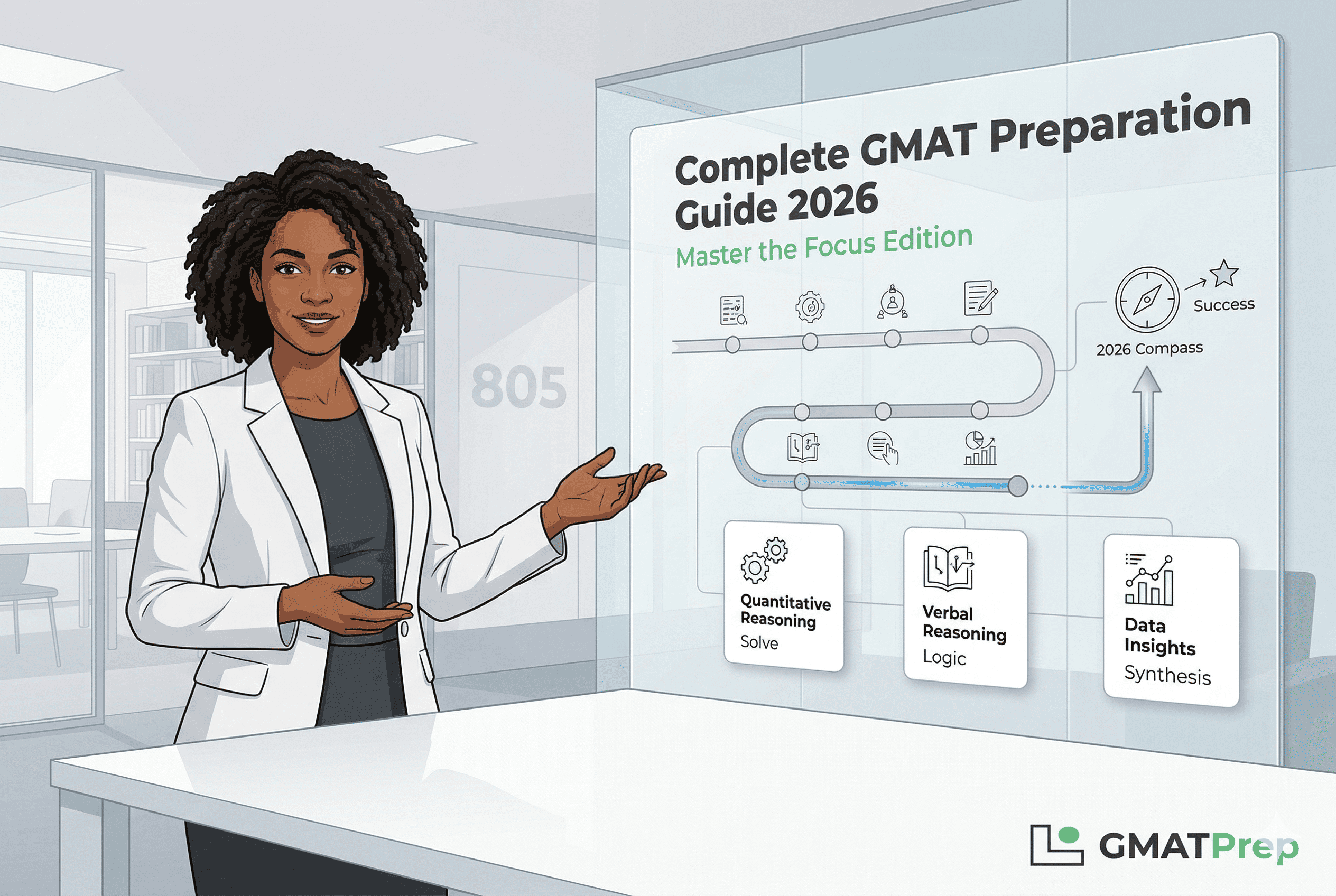
The landscape of graduate management admissions has shifted. As we move through 2026, the GMAT Focus Edition is no longer the “new” version of the exam—it is the global standard. For aspirants eyeing top-tier MBA programs, understanding the nuances of this streamlined, data-centric test is the first step toward a competitive application.
Effective GMAT preparation in 2026 requires more than just memorizing math formulas or grammar rules. It demands a sophisticated blend of logical reasoning, data literacy, and extreme time management. This pillar guide provides a comprehensive roadmap for your journey, from taking your first diagnostic mock to walking into the test center with 705+ confidence.
1. Understanding the GMAT Focus Edition (2026)
Before diving into study materials, you must understand the architecture of the test you are taking. The Focus Edition is shorter, more flexible, and more focused on the skills actually required in a modern business environment.
The Sectional Breakdown
The exam consists of three sections, each lasting 45 minutes. You can take them in any order you choose:
- Quantitative Reasoning (21 Questions): Focuses on algebra and arithmetic. Note: Geometry has been removed from the Focus Edition, though Coordinate Geometry remains.
- Verbal Reasoning (23 Questions): Focuses on Critical Reasoning and Reading Comprehension. Note: Sentence Correction has been removed.
- Data Insights (20 Questions): A core section that measures your ability to analyze and interpret data from multiple sources. It includes Data Sufficiency, Multi-Source Reasoning, Table Analysis, Graphics Interpretation, and Two-Part Analysis.
The Scoring Scale
The GMAT Focus Edition is scored on a scale of 205 to 805, in increments of 10. All three sections contribute equally to your total score. In the 2026 admissions cycle, a score of 705 is roughly equivalent to a 750 or 760 on the old “Classic” GMAT, placing you in the 99th percentile of test-takers.
2. Phase 1: Diagnosis and Baseline
Your GMAT preparation should never begin with a textbook. It should begin with data.
The Diagnostic Mock
Take a full-length, adaptive mock test under realistic conditions. Do not pause the timer. Do not use a calculator for Quant. The goal isn’t to get a high score; it’s to see where you are naturally strong and where you are vulnerable.
Analyzing the Results
Once you have your baseline, categorize your errors:
- Concept Gaps: You didn’t know the mathematical rule or the logical framework.
- Pacing Issues: You got the question right but took 4 minutes to do it.
- Execution Errors: You knew the concept but made a “silly” calculation mistake or misread the prompt.
3. Phase 2: Building the Foundation (The Content Phase)
Once you know your gaps, it is time to build. This phase usually takes 4–6 weeks of dedicated study.
Quantitative Reasoning: Logic Over Math
The GMAT is not a math test; it is a logic test that uses numbers.
- Arithmetic: Master number properties, remainders, and ratios.
- Algebra: Focus on inequalities, absolute values, and quadratic equations.
- Strategy: Learn to use “Picking Numbers” and “Back-solving” to bypass complex algebraic steps.
Verbal Reasoning: Mapping the Argument
Since Sentence Correction is gone, your focus must be on structural logic.
- Critical Reasoning: Learn to identify the Conclusion, Evidence, and Assumption of every argument. Practice “Pre-phasing” your answer before looking at the choices.
- Reading Comprehension: Don’t read for details; read for function. Why did the author write this paragraph? What is the “Tone” of the passage?
Data Insights: The New Frontier
Data Insights (DI) is often the most challenging section for 2026 aspirants because it is the most integrative.
- Data Sufficiency: Learn to determine if you have enough information without actually solving the problem.
- Interdependency: Practice switching between tabs in Multi-Source Reasoning to synthesize conflicting information.
4. Phase 3: Strategic Excellence (The Pacing Phase)
In 2026, the difference between a 605 and a 705 is often not knowledge—it is strategy.
The “Review and Edit” Feature
The Focus Edition allows you to bookmark questions and change up to three answers at the end of each section. This is a game-changer for GMAT preparation.
- The Strategy: Bookmark questions that are taking too long. Guess, move on, and return only if you have a time “surplus” at the end.
The “Bail Out” Strategy
You must be willing to “lose a battle to win the war.” If a question is a “Time Sink” (over 2.5 minutes), top scorers make an educated guess. This protects your mental energy for the rest of the section.
The Error Log
A master Error Log is non-negotiable. For every question you get wrong, record:
- The question source.
- The time taken.
- The “Why” behind the mistake.
- The “Takeaway” (How will I avoid this next time?).
5. Phase 4: Advanced Practice and Simulation
As you approach your test date, shift from doing hundreds of questions to doing high-fidelity simulations.
Question Quality Over Quantity
Do not waste time on “unofficial” questions that don’t mirror the GMAT’s logical traps. Focus on official GMAT Focus materials and high-quality, adaptive banks that utilize Item Response Theory (IRT) algorithms.
Mock Test Rhythm
Take one full mock test every 7–10 days. Use these to build “Test Stamina.” The GMAT is an intellectual marathon; you need to train your brain to stay focused for the full 135 minutes of testing time.
6. Phase 5: The Final Countdown
The last week of GMAT preparation is about “Tapering.”
- T-Minus 5 Days: Review your Error Log one last time. Do not take any more full mocks.
- T-Minus 48 Hours: Focus on light review and “Confidence Builders” (Easy/Medium questions).
- T-Minus 24 Hours: Stop studying entirely. Rest your brain. Ensure your ID and logistics are ready.
7. Sample Study Timelines
The 8-Week “Sprint” (For High-Baseline Scorers)
- Week 1: Diagnostic & Arithmetic Foundations.
- Week 2: Algebra & Critical Reasoning.
- Week 3: Reading Comprehension & Data Sufficiency.
- Week 4: Integrated Data Insights & Mid-point Mock.
- Week 5: Advanced Quant & Pacing Strategy.
- Week 6: Advanced Verbal & Mock #3.
- Week 7: Full Simulation Mode (Mock #4 & #5).
- Week 8: Review, Taper, and Test.
The 12-Week “Deep Dive” (For Career Switchers or Professionals)
- Weeks 1-4: Content Mastery (Quant & Verbal basics).
- Weeks 5-8: Strategy Development (DI Focus & Error Logging).
- Weeks 9-12: Advanced Application (Weekly Mocks & Forensic Review).
8. Common Pitfalls to Avoid in 2026
- Neglecting Data Insights: Many students spend 80% of their time on Quant and Verbal, only to be overwhelmed by DI on test day. DI requires its own dedicated study time.
- Cramming: The GMAT is a skill-based test, not a knowledge-based one. You cannot cram for logic.
- Ignoring Mental Health: Burnout is real. Schedule “Rest Days” where you do not think about the GMAT. A rested brain is a more logical brain.
9. Conclusion: Your Journey to 705+
Achieving your target GMAT score in 2026 is a project management exercise. It requires a clear baseline, a structured content phase, and a ruthless commitment to strategic execution. The GMAT does not just test your ability to solve for $x$; it tests your ability to make executive decisions under pressure—a skill you will use every day in business school and beyond.
The path to a top-tier MBA is challenging, but with the right GMAT preparation, it is entirely within your reach.
Ready to Begin Your Transformation?
Success on the GMAT is built on a solid plan. Don’t leave your MBA future to chance. Click the link below to access our comprehensive, customizable study schedule designed specifically for the 2026 Focus Edition.
Leave a Reply