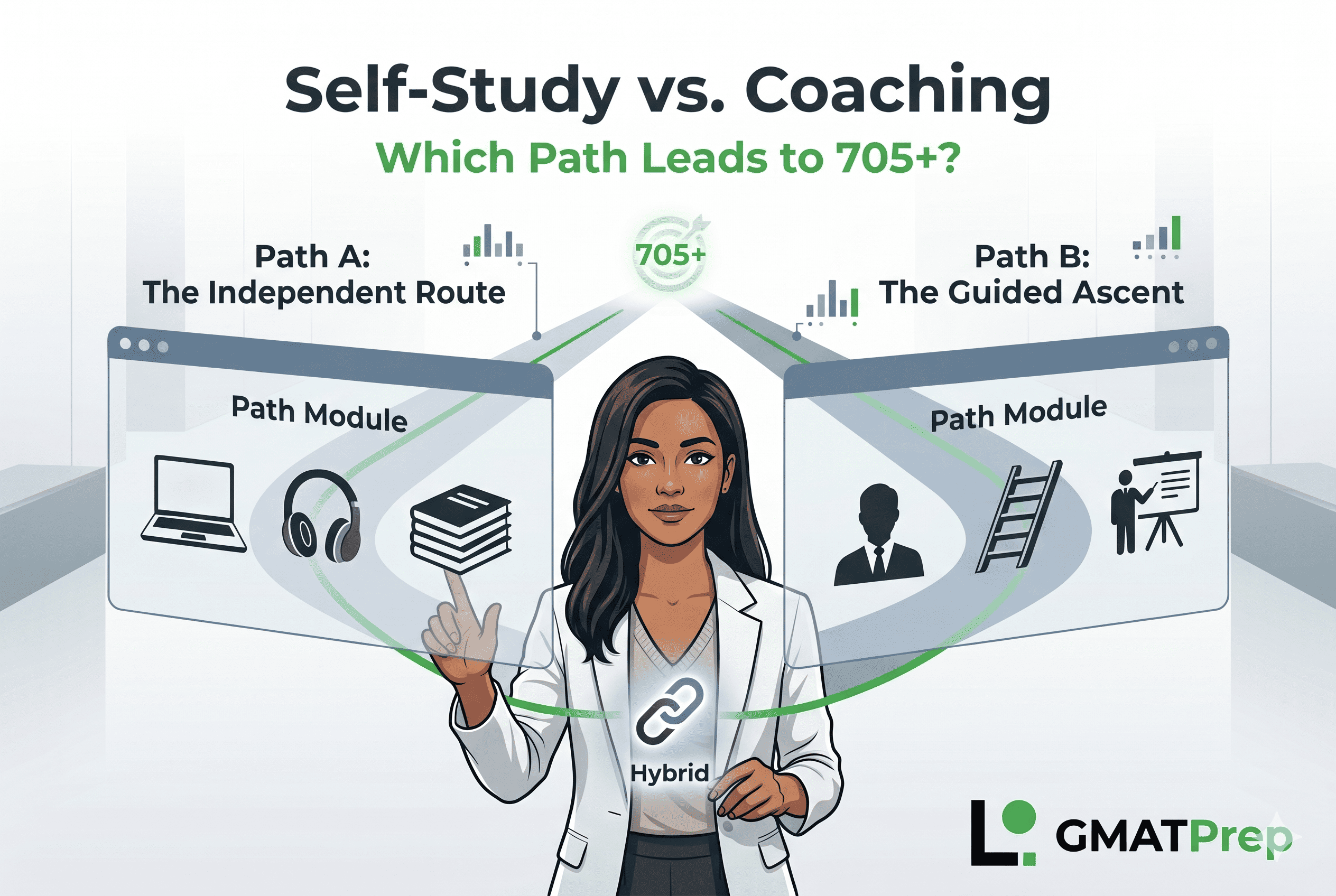
The journey to a top-tier MBA program is often defined by a single, formidable milestone: the GMAT. As we move through 2026, the GMAT Focus Edition has firmly established itself as the global standard for business school admissions. With its streamlined structure and heavy emphasis on Data Insights, the exam demands a more sophisticated approach to GMAT preparation than ever before.
One of the most critical decisions an aspirant faces at the start of this journey is the choice of methodology. Should you embark on a solo journey of self-study, or should you enlist the structured guidance of a coaching program?
There is no “one-size-fits-all” answer. The right choice depends on your baseline score, your learning style, your budget, and—perhaps most importantly—your executive discipline. This guide provides a forensic comparison of self-study and coaching to help you architect the most effective path to your target score.
The Landscape of the GMAT Focus Edition
Before comparing study methods, it is essential to understand the test. The GMAT Focus Edition consists of three equally weighted sections:
- Quantitative Reasoning: Focused on Algebra and Arithmetic.
- Verbal Reasoning: Focused on Critical Reasoning and Reading Comprehension.
- Data Insights: A sophisticated section testing your ability to synthesize data from multiple sources.
Because the sections are adaptive and the scoring scale (205–805) is rigorous, your GMAT preparation must be precise. Whether you study alone or with a coach, your goal is the same: to move from “knowing the concepts” to “mastering the logic.”
1. The Case for Self-Study: The Independent Pursuit
Self-study is the choice for the “Disciplined Autodidact.” In 2026, with the wealth of high-quality digital resources available, achieving a 99th-percentile score through self-study is more attainable than it was a decade ago.
The Advantages of Self-Study
- Total Flexibility: As a working professional, your schedule is rarely predictable. Self-study allows you to pivot. If a work crisis emerges, you can pause. If you have a burst of energy at 5:00 AM, you can dive into Data Insights without waiting for a scheduled class.
- Cost-Effectiveness: Coaching programs can be a significant investment. Self-study allows you to allocate your budget toward high-quality official mocks and specific question banks rather than expensive hourly instruction.
- Customized Pacing: In a classroom, the teacher must move at the average pace of the group. Self-study allows you to “fast-forward” through topics you find intuitive (like Arithmetic) and “deep-dive” into topics where you struggle (like Critical Reasoning).
- Building “Test Grit”: Solo preparation forces you to struggle with a problem until you find the logical breakthrough. This internalizes the logic more deeply than having a teacher simply explain the “shortcut.”
The Risks of Self-Study
- The “Blind Spot” Problem: You don’t know what you don’t know. Without an external auditor, you may continue to make the same logical errors without realizing there is a more efficient framework available.
- Motivation Wane: The GMAT is a marathon. Without the accountability of a coach or a cohort, it is easy for a “one-day break” to turn into a “one-month hiatus.”
- Resource Overload: There is too much content available online. Self-studiers often fall into the trap of “resource hoarding”—buying every book and subscription but mastering none.
2. The Case for Coaching: The Structured Ascent
Coaching is designed for the “Strategic Executive.” It treats GMAT preparation as a managed project with expert oversight.
The Advantages of Coaching
- The “Shortcut” Advantage: Expert coaches have analyzed thousands of GMAT questions. They can teach you to recognize the “DNA” of a question in 10 seconds, providing frameworks that bypass complex calculations or dense reading.
- Structured Accountability: A coaching program provides a syllabus and a timeline. Knowing you have a session on Saturday morning prevents the procrastination that often plagues self-studiers.
- Immediate Feedback: When you are stuck on a Data Insights prompt, having a mentor explain the synthesis of the data in real-time saves hours of frustrated solo searching.
- Peer Benchmarking: Being part of a high-achieving cohort allows you to see how your peers are performing. This “healthy competition” can drive you to work harder.
The Risks of Coaching
- Passive Learning: Many students fall into the trap of thinking that simply “attending” class is the same as “learning.” If you rely too heavily on the coach’s explanations, you may find yourself unable to replicate that logic under the pressure of the actual exam.
- Financial Investment: Premium coaching comes at a premium price. For some, the return on investment (ROI) may not justify the cost if they are already starting from a high baseline score.
- Rigid Schedules: Fixed class times can be difficult for professionals with volatile work hours. Missing a foundational class can leave you playing catch-up for weeks.
3. The Comparison Matrix
| Feature | Self-Study | Coaching |
| Cost | Low to Moderate | High |
| Schedule | Fully Flexible | Fixed / Semi-Flexible |
| Accountability | Self-Generated | External / Group-Driven |
| Strategy | Trial & Error / Discovery | Expert-Led / Framework-Focused |
| Best For | High-discipline, budget-conscious | Students needing structure/shortcuts |
| Risk | Procrastination & Blind Spots | Passive Learning & High Cost |
4. The Decision Framework: Which Path for You?
To decide which path of GMAT preparation is right for your goals, evaluate yourself against these four criteria:
A. Your Baseline Score
Take a “cold” diagnostic mock.
- If you are at 605+: You likely have strong foundational logic. Self-study with a focus on advanced strategy may be enough to bridge the gap to 705+.
- If you are below 555: You may have significant concept or logic gaps. A structured coaching program can help you build these foundations more quickly than solo study.
B. Your Executive Discipline
Be honest with yourself. Can you sit down for 90 minutes every morning at 6:00 AM without someone telling you to do so?
- Yes: Self-study will suit your autonomy.
- No: You need the external structure of coaching to keep you on track.
C. Your Learning Style
- The Scientist: If you enjoy deconstructing problems and finding your own solutions, self-study is rewarding.
- The Apprentice: If you prefer to be shown a “Best Practice” and then refine it through application, coaching will yield faster results.
D. Your Timeline
- Short Timeline (8 weeks): Coaching can provide a “crash course” in shortcuts and strategy that would take months to discover on your own.
- Long Timeline (6+ months): Self-study allows you to move slowly and deeply through concepts without the pressure of a class schedule.
5. The Middle Path: The Modern Hybrid Solution
In 2026, the binary choice between “books only” and “private tutor” has vanished. The most successful aspirants are moving toward a Hybrid Approach.
This involves using an AI-driven, adaptive platform that offers the benefits of coaching (structure, analytics, expert frameworks) with the benefits of self-study (flexibility, lower cost, personalized pacing).
A Hybrid Platform provides:
- Deep Analytics: It acts as your “Automated Coach,” identifying your weak areas so you don’t have to guess.
- Expert Video Instruction: You get the “shortcuts” of a coach but can watch them whenever your schedule allows.
- Structured Study Plans: You don’t have to architect your own roadmap; the platform does it for you based on your target date.
6. Common Pitfalls in Both Paths
Regardless of your chosen path, certain GMAT preparation mistakes can derail your score:
- The Error Log Neglect: Self-studiers often skip the error log because it’s tedious; coaching students often skip it because they think the class notes are enough. Without a rigorous error log, you are not improving; you are just practicing.
- Mock Test Avoidance: Both groups often wait too long to take full-length mocks. You must test your “Test Stamina” early and often.
- Section Imbalance: Many students over-prepare for Quant because it feels “tangible” while neglecting the nuances of Verbal or the integrative complexity of Data Insights.
7. Conclusion: The Strategy is the Success
The GMAT Focus Edition does not care how you learned the logic; it only cares that you can apply it with 100% precision under time pressure.
Self-study offers the freedom of the independent path, while coaching offers the safety and speed of the guided path. If you are a high-discipline individual with a strong baseline, the independent route is a viable, cost-effective journey. If you are a busy professional who values expert shortcuts and needs a structured roadmap to stay accountable, coaching is an investment in your MBA future.
However, remember that the most expensive coaching in the world cannot replace the “Deep Work” required of the student. Conversely, the best textbooks are useless without a strategic plan.
Which path will you choose for your 705+ journey?
Success begins with the right environment. Whether you want to study independently or desire the structure of an expert-led system, you need a platform that mirrors the actual GMAT experience. Experience the most advanced, adaptive GMAT Focus Edition simulation available today.
Leave a Reply