For most GMAT aspirants, the moment the “Submit” button is clicked on a practice exam is met with a mixture of dread and anticipation. That three-digit number that flashes on the screen—the GMAT mock score meaning—is often treated as a final verdict on one’s intelligence or MBA prospects.
However, a mock score is not a destination; it is a data point. In the context of the GMAT Focus Edition, interpreting these scores requires a more nuanced approach than simply looking at a total value. Because the exam is now shorter and more integrated, every point carries a different weight in terms of your percentile ranking.
In this guide, we will perform a deep-dive score analysis to help you understand what your results are actually telling you about your logic, your stamina, and your readiness for the real test center.
1. Decoding the Score Tiers
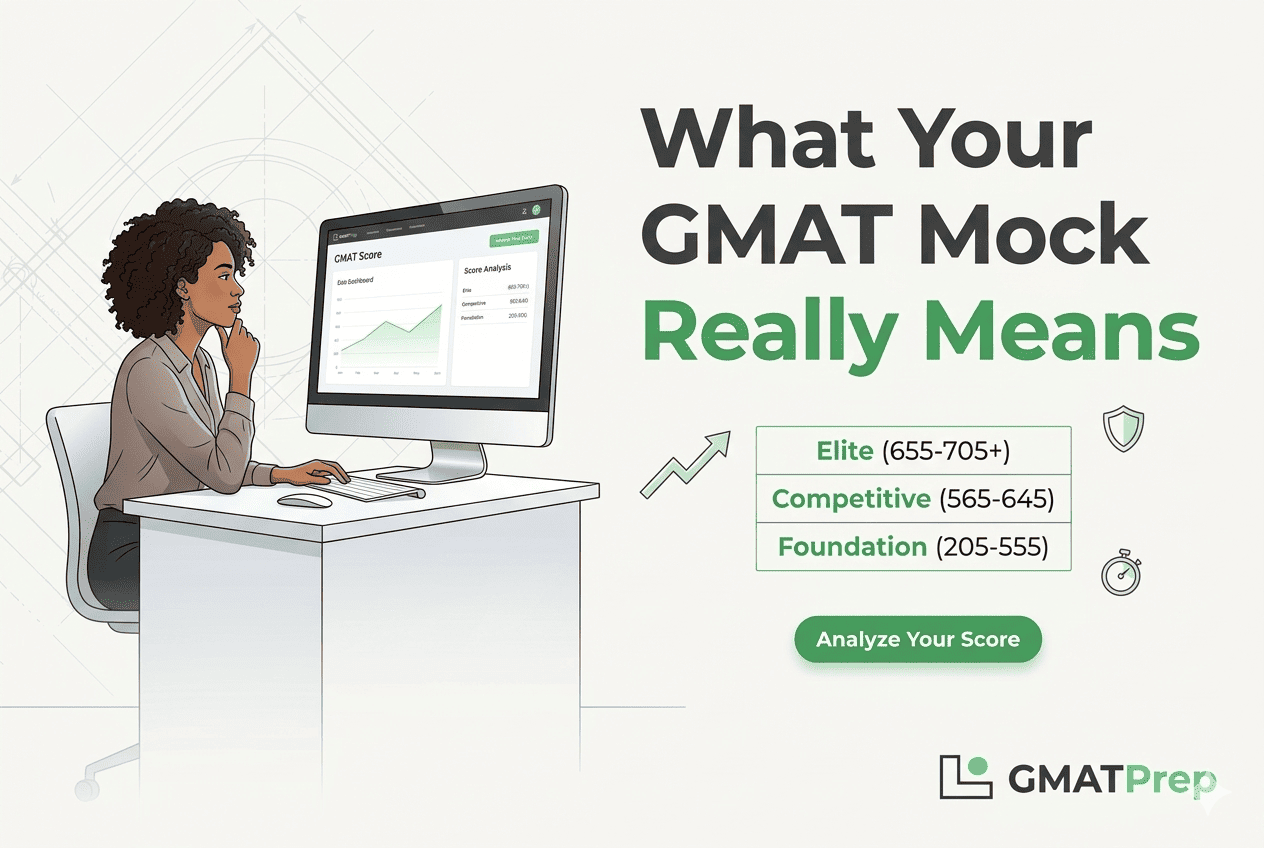
On the GMAT Focus Edition, the total score ranges from 205 to 805, with all three sections (Quant, Verbal, and Data Insights) contributing equally. To interpret practice scores effectively, you must categorize your current standing into one of three primary preparation tiers.
Tier 1: The Foundation (205 – 555)
If your mock score falls in this range, it typically indicates significant “Concept Gaps.”
- The Meaning: You likely understand the basics of arithmetic or grammar, but you are struggling with GMAT-specific logic. You might be falling for “Trap Answers” frequently or finding that you don’t know the specific rules for Data Sufficiency or Critical Reasoning.
- The Prep Fix: Stop taking mocks for a few weeks. Focus on foundational content. You cannot “strategize” your way out of a knowledge gap.
Tier 2: The Competitive Middle (565 – 645)
This is the most common range for students midway through their journey.
- The Meaning: You know the concepts, but your “Process” is inconsistent. You likely have “Timing Volatility”—meaning you move too fast on some questions (careless errors) and get stuck on others (time sinks).
- The Prep Fix: Shift from content study to “Forensic Review.” Analyze why you are missing medium-difficulty questions. Are you misreading the prompts? Are you failing to use the “3-change review” feature?
Tier 3: The Elite Zone (655 – 705+)
Scores in this range are highly competitive for top-tier business schools.
- The Meaning: You have mastered the content and the timing. At this level, your errors are likely “Edge Cases” or high-level logic traps. You are consistently reaching the 90th percentile in at least two sections.
- The Prep Fix: Focus on “Biological Peak Conditioning” and stress management. Your goal now is to reduce “Score Volatility” so that your test-day performance matches your best mock.
2. The Truth About Score Volatility
A common frustration among test-takers is seeing a 655 on Monday and a 605 on Thursday. Does this mean you “lost” knowledge?
No. It indicates Score Volatility.
Your GMAT score is actually a “confidence interval.” On any given day, your true ability might be a 635, but depending on the specific mix of questions the algorithm throws at you, you might score anywhere from 615 to 655.
- The Rule of Three: Never trust a single mock score. To find your true baseline, take the average of your last three mocks.
- Predicting Success: Use a Score predictor to see how your sectional performance translates into a final percentile. If your Quant is 90th percentile but your DI is 60th, the predictor will help you see where the “Low Hanging Fruit” for improvement lies.
3. Sectional Imbalance: Where the Data Lies
The most important part of your GMAT mock score meaning isn’t the total number; it’s the sectional breakdown.
High Quant / Low Verbal
This suggests a “Language or Logic Gap.” You might be treating Verbal like a math problem where you “calculate” an answer, rather than analyzing the structure of the argument. You likely need to work on your Reading Comprehension (RC) roadmaps.
High Verbal / Low Data Insights
This often indicates a “Synthesis Gap.” You can understand complex sentences, but you struggle when those sentences are paired with charts or tables. Since Data Insights (DI) is now a core section, this imbalance will cap your total score significantly.
High Quant & Verbal / Low DI
This is almost always a “Stamina or Decision Fatigue” issue. Because DI is often taken last, your brain might be running out of fuel. You need to practice DI when you are already tired to build the necessary “Mental Muscle.”
4. Understanding the “Theta” Engine (IRT)
The GMAT doesn’t use a simple “points per correct answer” system. It uses Item Response Theory (IRT) to estimate your ability level, often referred to as “Theta”.
This means that when you miss a question matters as much as how many you miss.
- Early Misses: Missing “Easy” or “Medium” questions in the first third of a section is devastating. It “caps” the difficulty the engine will show you, making it mathematically difficult to reach a high score even if you get everything right thereafter.
- The “Hero” Kill: If you encounter a question that is clearly beyond your ability, “killing” it (guessing and moving on) protects your time for the medium questions that keep your Theta stable.
5. Beyond the Number: The “Hidden” Metrics (Wildcard)
While the dashboard shows you a score, a truly effective score analysis looks at the psychological and behavioral metrics that the computer doesn’t explicitly label.
The “Stress Spike”
Look at your time-per-question graph. Do you see a 4-minute investment followed by three 30-second guesses? That is a “Stress Spike.” It indicates that you lost emotional control. On the real exam, these spikes are the primary cause of score collapses.
The “Silly Mistake” Audit
During your review, categorize every error. If more than 20% of your errors are “Silly Mistakes” (misreading a ‘not’, simple arithmetic errors), your problem isn’t the GMAT—it’s your “Audit Process.” You need to slow down and verify your work before clicking “Next.”
6. How to Use Your Mock Results to Pivot
Once you have completed a mock on our Mock test page, don’t just move on to more practice problems. Use the data to pivot your study plan.
- If Accuracy > 80% but Time is High: Work on “Pattern Recognition.” You know how to solve the problems, but you are taking the “long way” home. Look for shortcuts and logical estimations.
- If Time < Average but Accuracy is Low: You are rushing. You are likely trying to “beat the clock” at the expense of the “Theta Engine.” Slow down and focus on getting the first 10 questions of every section correct.
- If Both are Low: Rebuild your conceptual foundations. You are likely guessing because you don’t know the rules.
Conclusion: The Mock is a Mirror
Your GMAT mock score is a mirror that reflects your current habits—both good and bad. A 505 isn’t a failure; it’s a signal that your foundations need reinforcement. A 685 isn’t a guarantee; it’s a signal that you have the tools but need to refine your execution under pressure.
To truly master the GMAT, you must stop being “Score-Obsessed” and start being “Process-Obsessed.” Analyze your milestones, use a Score predictor to set realistic targets, and treat every practice exam as a laboratory for your decision-making.Ready for an honest assessment? Visit our Mock test page to take a full-length, adaptive Focus Edition mock. Our forensic performance reports will give you the detailed score analysis you need to stop wondering what your score means and start knowing how to improve it.
Leave a Reply