For many GMAT aspirants, the Verbal section feels like a subjective minefield. You narrow a Critical Reasoning question down to two options, pick the one that “feels” right, and then watch in frustration as the official explanation tells you why the other choice was logically superior. If your score has plateaued, it’s likely because you are relying on intuition rather than a repeatable, logical process.
To break through this barrier, you must treat GMAT verbal mocks as more than just a score generator. They are diagnostic tools designed to reveal the flaws in your reasoning and the gaps in your mental stamina. In the GMAT Focus Edition, where Sentence Correction is a thing of the past, the emphasis has shifted entirely to logic, comprehension, and data interpretation.
In this guide, we will explore how to use verbal mock tests to master the adaptive algorithm, refine your pacing, and perform the kind of deep-seated error analysis required to hit a 90th-percentile score.
1. Decoding the Adaptive Verbal Algorithm
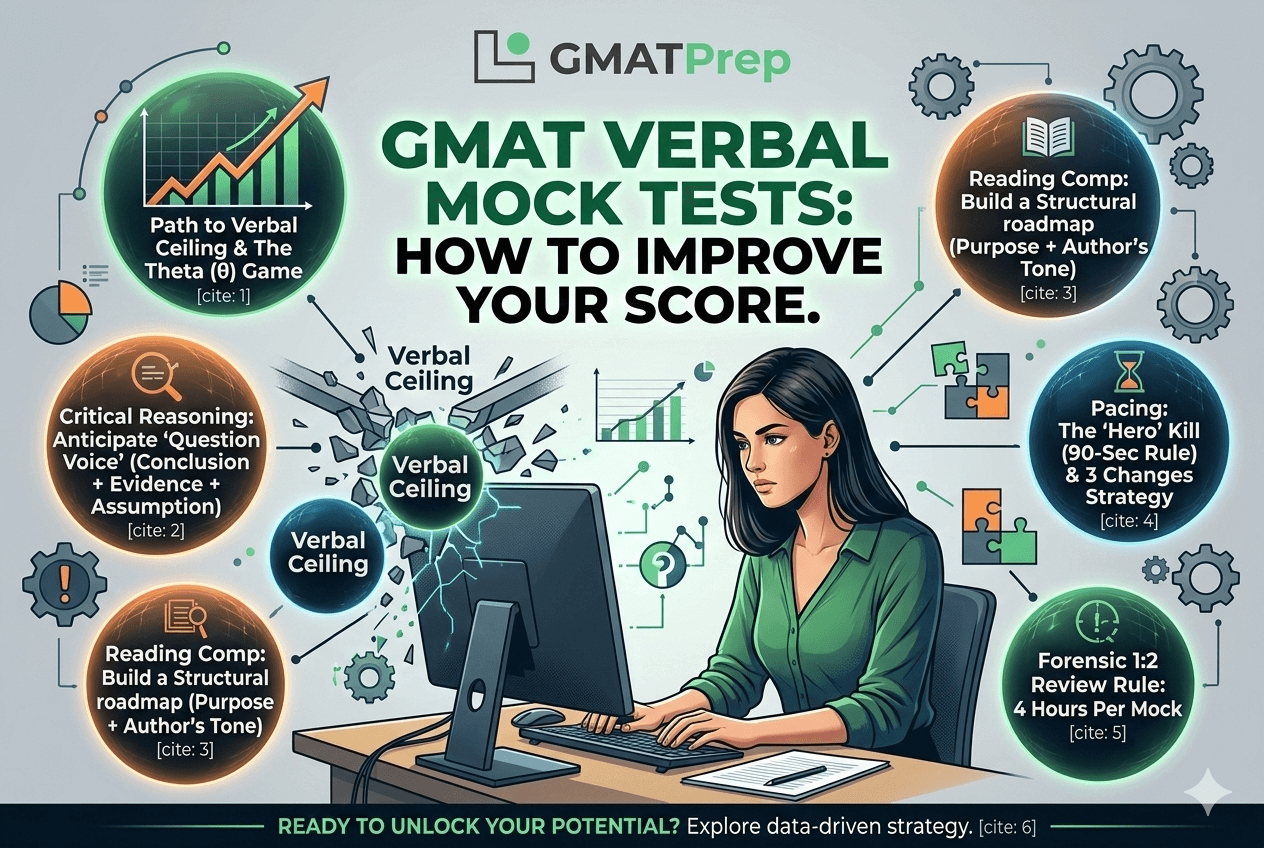
Just like the Quant section, the GMAT Verbal section is a Computer Adaptive Test (CAT). This means your score is not determined by the number of questions you get right, but by the difficulty level of the questions you consistently solve correctly.
Theta (θ) and the “Verbal Ceiling”
The algorithm maintains a running estimate of your ability, known as Theta. Every time you submit an answer, the computer re-evaluates your level:
- Correct Answer: The difficulty increases, pushing your Theta higher.
- Incorrect Answer: The difficulty drops to find your “floor”.
The mistake many students make during GMAT verbal practice is trying to “game” the system by over-thinking the first few questions. Instead, focus on maintaining a high accuracy rate on medium-difficulty questions to ensure the algorithm never drops you into the “low-difficulty trap,” from which it is statistically difficult to recover.
2. Critical Reasoning: Replacing Intuition with Logic
In GMAT verbal mocks, Critical Reasoning (CR) is often where time management falls apart. Students often read the passage and the options multiple times, waiting for one to “sound” correct.
The “Question Voice” Strategy
Successful test-takers don’t wait for the right answer to appear; they predict it. Before looking at the options:
- Identify the Conclusion: What is the author trying to prove?
- Find the Evidence: What facts are provided?
- Identify the Assumption: What is the unstated link between the evidence and the conclusion?
By anticipating the answer, you avoid the “Hero Complex”—the urge to spend three minutes debating two similar-sounding options. If you cannot find the logical flaw in 90 seconds, it is time to use a “Keep or Kill” mindset: make an educated guess, bookmark the question, and move on.
3. Reading Comprehension: The “Active Reading” Advantage
Reading Comprehension (RC) on the GMAT is not a test of memory; it is a test of structural understanding. Many students fail their verbal mock tests because they read for “what” the passage says instead of “why” the author wrote it.
The Mental Roadmap
While taking your mock, your scratchpad should not be empty. Briefly note:
- The Purpose of each paragraph: (e.g., P1: Introduces theory; P2: Challenges theory; P3: Provides middle ground).
- The Author’s Tone: Is it neutral, critical, or advocates for a specific view?
This “active reading” prevents you from having to re-read the entire passage for every question, which is one of the most common GMAT preparation mistakes that leads to a time crunch in the final minutes of the section.
4. Pacing: The Silent Score Killer
Verbal pacing is different from Quant pacing. While Quant involves calculations, Verbal involves “processing load.” As you get tired, your ability to process complex sentences diminishes—a phenomenon known as decision fatigue.
The 90-Second Rule & The Review Feature
The GMAT Focus Edition offers a “Question Review” feature that allows you to change up to three answers at the end of the section.
- The Tactic: If a passage is particularly dense or a CR question is circular, don’t let it ruin your momentum. Spend no more than 2 minutes on it.
- The “Kill”: Guess, bookmark it, and protect your time for the easier questions later in the section.
A common mistake in GMAT verbal mocks is rushing the last five questions because you spent too much time “fighting” a high-difficulty RC question earlier. Remember, the penalty for not finishing the section is severe.
5. The 1:2 Review Rule for Verbal
If you take a 2-hour mock, you must spend at least 4 hours reviewing it. For Verbal, the review must be forensic. You need to know exactly why you chose the wrong answer and why the right answer is logically airtight.
Categorizing Your Verbal Errors
Divide every mistake into these three categories:
- Comprehension Gap: You simply didn’t understand what a sentence meant (e.g., you missed a “not” or a “except”).
- Logic Trap: You fell for an “Out of Scope” or “Reverse Logic” answer choice.
- Pacing/Stamina Error: You got the question wrong because you were rushing or had lost focus.
If you find a pattern of Comprehension Gaps, spend the next three days on our Verbal quiz page performing untimed drills to build your reading “muscle” before taking your next mock.
6. Integrating “State-Dependent Learning”
Your performance on verbal mock tests is heavily influenced by your internal state. Because Verbal requires high-level linguistic processing, taking a mock while tired is counterproductive.
The Optimal Window
- Morning Peak: Most students find their logical reasoning is sharpest in the morning.
- Simulation: Always take your GMAT verbal mocks at the same time as your actual exam. If your exam is at 11:30 AM, taking a mock at 10:00 PM after a long workday will give you an inaccurate “Decision Fatigue” score that doesn’t reflect your true potential.
7. The 30-Day Verbal Improvement Roadmap
To see a significant jump in your score, follow this structured score improvement plan:
- Phase 1 (Baseline): Take a diagnostic mock to find your Verbal “Theta”.
- Phase 2 (Analytics): Take two adaptive mocks on our Mock test page. Use the analytics to see if your accuracy drops during long RC passages.
- Phase 3 (Simulation): Practice strict test conditions. Use a laminated scratchpad and no snacks.
- Phase 4 (Final Polish): Use official mocks to calibrate your ear to the “Official GMAT Voice”.
Conclusion: Mastering the Logic of the Exam
Improving your Verbal score is not about learning more vocabulary; it is about refining your logical filter. By avoiding common GMAT preparation mistakes like skipping the review or ignoring simulation, you can turn the Verbal section into a consistent strength.
Your GMAT verbal mocks are the mirror that shows you your flaws. Use them to fix your form, master your pacing, and build the mental stamina required for a 705+ score.
Ready to identify your verbal “black holes”? Head to our Mock test page to take a full-length, adaptive mock today. Then, use your analytics to target your weak sub-topics on the Verbal quiz page and watch your score climb.
Leave a Reply