Is your GMAT score stuck in a plateau? You’ve put in the hours, memorized the formulas, and practiced hundreds of questions, yet that target score of 705+ remains frustratingly out of reach. When your score refuses to budge, it’s usually not a lack of knowledge—it’s a lack of a structured, tactical score improvement plan.
To improve GMAT mock score results, you need more than just “more practice.” You need a high-intensity, data-driven approach that addresses content gaps, psychological stamina, and the nuances of the GMAT algorithm.
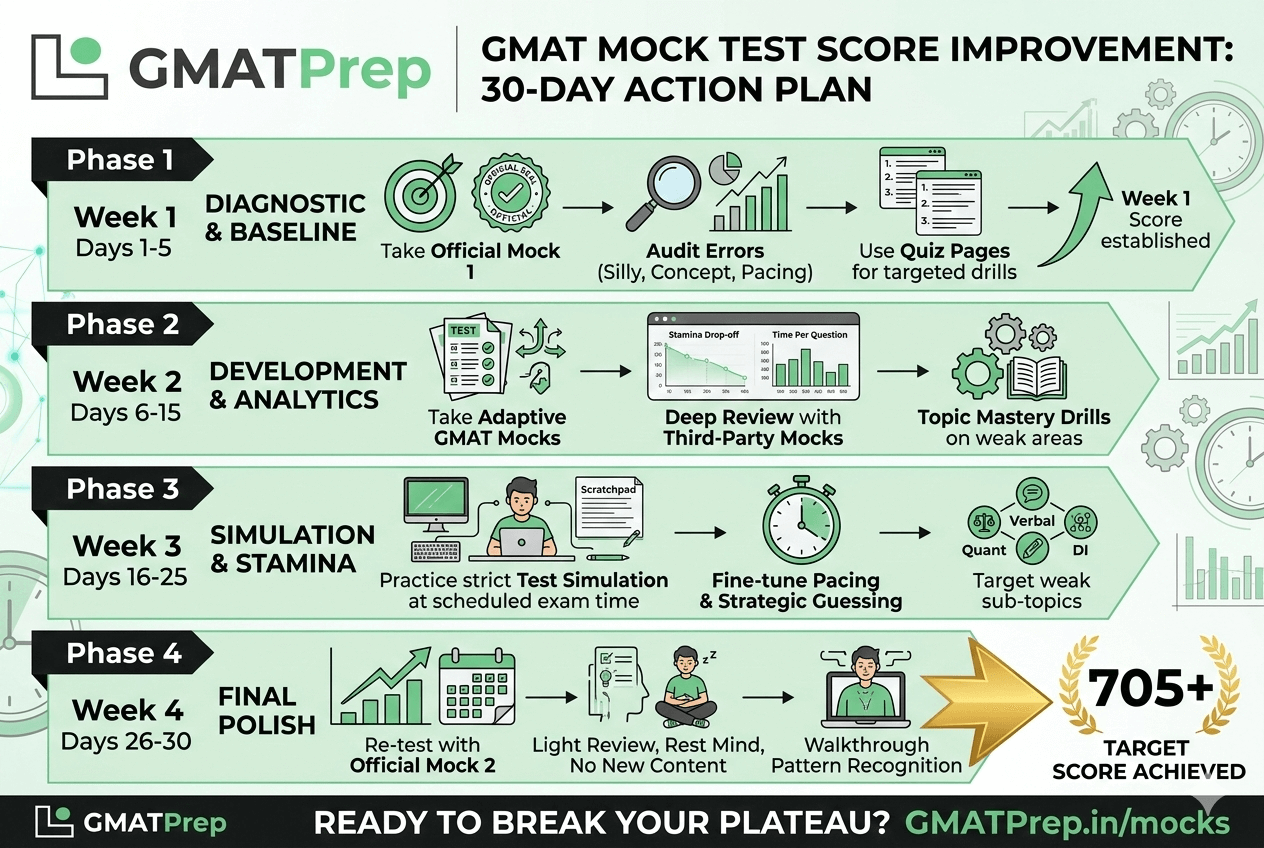
This 30-day action plan is designed to take you from a score plateau to peak performance by combining the “Hybrid Strategy” of official and third-party resources with rigorous realistic practice.
The Philosophy of the 30-Day Plan
Before diving into Day 1, you must accept three fundamental truths of GMAT success:
- Review is more important than doing: You must follow the 1:2 Rule—spend two hours reviewing for every one hour of testing.
- Simulation is non-negotiable: You cannot increase GMAT score outcomes if you practice in pajamas on your couch.
- Data-Driven Decisions: You will use advanced analytics to identify your “Visual Error Log” and fix weaknesses with surgical precision.
Phase 1: The Diagnostic & Baseline (Days 1–5)
The goal of this phase is to establish your “unvarnished baseline” and identify the specific content “black holes” dragging your score down.
Day 1: The Diagnostic Mock
Take Official Mock 1 from GMAC. This provides the most accurate initial score because it uses the actual proprietary scoring algorithm.
- Task: Complete the full exam under strict GMAT exam conditions.
- Goal: Establish your starting “Theta” estimate.
Day 2: The Deep-Dive Audit
Do not touch a new practice question today. Instead, perform a 4-hour audit of your diagnostic mock.
- Task: Categorize every mistake into one of three buckets: Silly Mistake, Concept Gap, or Pacing Issue.
- Internal Link: Use our Quiz pages to take short 10-question drills in your weakest sub-topics to confirm if the issue is conceptual.
Day 3–5: Foundational Repair
Focus exclusively on the “Concept Gaps” identified on Day 2. If you missed three Number Properties questions, you don’t need more mocks—you need to re-learn Number Properties.
- Task: Study the theory and complete 20–30 medium-difficulty “untimed” questions for each weak area.
Phase 2: The Development Phase (Days 6–15)
In this phase, you will use adaptive GMAT mocks from third-party providers to preserve your limited supply of official exams while gaining deep analytical insights.
Day 6: Third-Party Mock #1
Take an adaptive mock on our Mock test page.
- Strategy: Use this test specifically to practice your “Keep or Kill” mindset—never spend more than 90 seconds on a question without a clear path to the solution.
Day 7–8: Analytics & Error Logging
Third-party mocks provide the “Visual Error Log” that official mocks lack.
- Task: Identify your “Stamina Drop-off” points. Are you missing more questions in the last 10 minutes of the Data Insights section?.
Day 9–12: Topic Mastery Drills
- Task: Use the analytics to create “Targeted Drills.” If your Data Insights score is low, treat it as a core section, not an elective. Spend two days mastering Table Analysis and Multi-Source Reasoning on the Quiz pages.
Day 13: Third-Party Mock #2
- Goal: Focus on “Recalibration.” Use the review feature of the Focus Edition to see if changing your three allowed answers actually improves your score.
Day 14–15: Pacing Refinement
Analyze your “Time Per Question” for every topic. If you are taking 3 minutes for Critical Reasoning, you are sabotaging your Verbal score regardless of your accuracy.
Phase 3: Simulation & Stamina (Days 16–25)
By now, your content knowledge should be solid. This phase is about the “Environment Gap”—ensuring you can perform under the physical and mental stress of GMAT test simulation.
Day 16: The Hardware Check
- Task: Set up your desk with an external monitor, a wired keyboard, a standard mouse, and a laminated scratchpad.
Day 17: Third-Party Mock #3
- Task: Take this mock at the exact time of day your real exam is scheduled (e.g., 8:00 AM).
Day 18–19: The 1:2 Review
Spend double the time of the test reviewing your errors. Focus on “Strategic Guessing.” Did you guess on the right questions, or did you waste time on “Hero” questions?.
Day 20–22: Advanced Verbal & Quant Logic
The GMAT Verbal and Data Insights sections use subtle “logic traps”.
- Task: Go back to Official Mock 1 and re-solve every Verbal question you missed. Can you see the “Question Voice” and the traps GMAC set for you?.
Day 23: Third-Party Mock #4
- Goal: Final “Stamina Building.” This is your last “Training at Altitude” mock—if it feels harder than the real thing, that’s a good sign for your test-day confidence.
Day 24–25: Final Weakness Patching
Check your Quiz pages performance data. One final push on your bottom 10% of topics.
Phase 4: The Final Polish (Days 26–30)
In the final five days, you switch back to the “Gold Standard” official mocks to recalibrate your brain to the official GMAC voice.
Day 26: Official Mock 2
- Task: Take this under 100% perfect GMAT exam conditions. No exceptions.
Day 27: The “No New Content” Review
Analyze Official Mock 2. If you still have concept gaps, it’s too late to learn them from scratch. Focus on minimizing “Silly Mistakes” and “Reactionary Changes” based on “Post-Mock Blues”.
Day 28: Strategic Walkthrough
Don’t take a test. Instead, open a set of 50 hard questions and, without solving them, spend 30 seconds on each identifying the “Path to Solution.” This builds your “Pattern Recognition” muscle.
Day 29: Light Review & Mindset
- Task: Review your “Success Log”—the hardest questions you’ve solved correctly over the last 30 days. Remind yourself that the GMAT algorithm wants to find your peak level, not just punish your mistakes.
Day 30: Rest
No GMAT today. Your brain needs 24 hours of “cool down” to ensure maximum cognitive speed for the actual exam.
Daily Schedule Template (Weekly Breakdown)
| Week | Primary Focus | Mock Test Goal |
| Week 1 | Diagnosis & Content Repair | Official Mock 1 (Baseline) |
| Week 2 | Development & Analytics | 2 Third-Party Adaptive Mocks |
| Week 3 | Pacing & Stamina | 1 Third-Party Mock (Strict Simulation) |
| Week 4 | Recalibration & Polish | Official Mock 2 (Final Prediction) |
Crucial Tactics to Increase GMAT Score Results
The “Keep or Kill” Mindset
In an item-adaptive test, your pacing is part of your score. If you spend 4 minutes on Question 5, the computer may never give you a chance to reach the 700-level questions because you’ll be rushing the end.
The 10-Minute Break Strategy
On the Focus Edition, you have one 10-minute break. Use it to hydrate and perform deep breathing to reset your cortisol levels. Never skip this break during your mocks.
Addressing the Data Insights “Weight”
Remember, Data Insights is now a core section. Your score improvement plan must dedicate at least 30% of your time to DI practice on our Quiz pages.
Conclusion: Commitment to the Plan
To improve GMAT mock score levels, you must stop treating mock tests as “just another practice session.” They are a diagnostic tool, a psychological hurdle, and a predictor of your future success.
This 30-day plan works because it balances the pinpoint accuracy of GMAC with the diagnostic power of GMATPrep.in. By identifying your trends, simulating the stress of the center, and following the 1:2 review rule, you transform from a passive student into a strategic test-taker.Are you ready to break your plateau? Start your 30-day journey today. Visit our Mock test page to take your first adaptive exam and get the advanced analytics you need to build your customized score improvement plan.
Leave a Reply