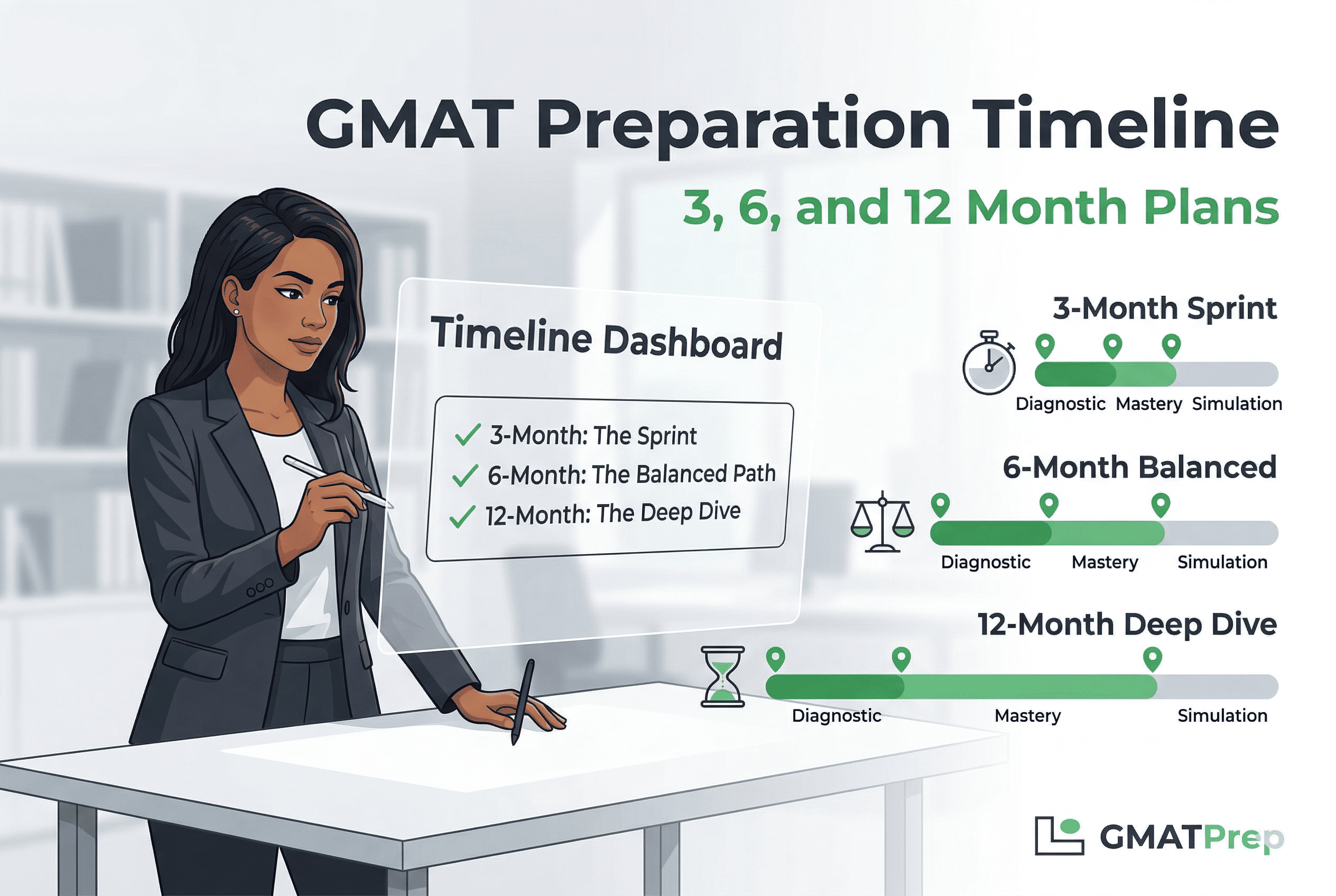
The most frequent question asked by MBA aspirants isn’t about a specific geometry rule or a critical reasoning flaw—it’s about time. “How long will it take me to get a 705+?”
The answer, while frustrating, is: It depends. It depends on your starting baseline, your target score, your professional commitments, and your “learning velocity.” However, hope is not a strategy. To conquer the GMAT Focus Edition in 2026, you need a rigorous, data-driven GMAT preparation timeline that aligns with your lifestyle.
Whether you are a “Sprinter” with three months to spare or a “Marathoner” planning a year in advance, this guide provides the granular roadmap you need to navigate the three pillars of the exam: Quantitative Reasoning, Verbal Reasoning, and Data Insights.
The “Day Zero” Requirement: The Diagnostic Baseline
Before choosing a timeline, you must know your starting point. You cannot plan a journey without a GPS coordinate for your current location.
The Action: Take a full-length, official-style diagnostic mock test immediately.
- If your baseline is within 50-80 points of your target: A 3-month plan is viable.
- If the gap is 100-150 points: A 6-month plan is recommended.
- If the gap is 200+ points or you are non-native in English: A 12-month plan is the safest path to mastery.
1. The 3-Month Plan: “The Sprint”
Best for: Students with high diagnostic scores (605+), full-time studiers, or those with very strong quantitative and analytical foundations.
This timeline is high-intensity. It requires 15–20 hours of study per week. There is no room for “concept wandering”; you must be surgical in your execution.
Month 1: The Content Blitz
- Weeks 1-2 (Quant): Refresh Algebra and Arithmetic. Focus on number properties, ratios, and inequalities.
- Weeks 3-4 (Verbal): Master the “Logic of the Argument” for Critical Reasoning. Learn “Structural Mapping” for Reading Comprehension.
- Goal: Complete 100% of the core syllabus concepts.
Month 2: Strategy and Data Insights
- Weeks 5-6 (Data Insights): Dive into Data Sufficiency and Multi-Source Reasoning. DI is often the hardest section to “cram,” so start early.
- Weeks 7-8 (Pacing): Move from untimed practice to timed sets. Implement the “2-Minute Rule”—if you don’t know the path to the answer in 90 seconds, guess and move on.
- Mid-Point Check: Take Mock #2.
Month 3: Simulation and Tapering
- Weeks 9-11: Take one mock test every 7 days. Spend 2 days performing a forensic review of each mock.
- Week 12: Review your Error Log. Focus on “Medium” questions to solidify your floor.
- The Final Week: No new mocks. Rest, hydrate, and visualize the 705+.
2. The 6-Month Plan: “The Professional’s Choice”
Best for: Working professionals with 40-60 hour work weeks who need a sustainable pace without burning out.
This is the most popular GMAT preparation timeline. It allows for 8–10 hours of study per week, typically 1 hour on weekdays and 3-4 hours on weekends.
Months 1-2: The Foundation Phase
- Focus: Re-learning how to think.
- Activities: Focus heavily on Quant basics. Many professionals haven’t done “pencil and paper” math in years. Spend Month 2 on Verbal foundations, specifically focusing on identifying assumptions in arguments.
Months 3-4: Advanced Application
- Focus: Data Insights and Advanced Quant.
- Activities: Start integrating Data Insights (DI) three times a week. DI requires “Synthesis Skills” that only develop with time. Begin your master Error Log, categorized by “Reason for Error” (Concept, Pacing, or Silly Mistake).
Months 5-6: The Refinement Phase
- Focus: Full Mocks and Sectional Stamina.
- Activities: Transition to “Mixed Sets” (Quant/Verbal/DI all in one sitting). Take a mock test every two weeks. Use the “Review & Edit” feature in your mocks to see if your second-guessing is helping or hurting your score.
3. The 12-Month Plan: “The Deep Dive”
Best for: Career switchers, non-native English speakers, or those targeting the 99th percentile (735+) from a low baseline.
A year-long timeline isn’t about studying more; it’s about studying deeper. It allows for a “Mastery Approach” where you don’t move to Chapter 2 until you have 90% accuracy in Chapter 1.
Quarter 1: Arithmetic & Reading Mastery
- Focus on the “language” of the test. Read long-form articles (Economist, Scientific American) to build Reading Comprehension stamina. Build a “Mental Math” foundation to save time in Quant.
Quarter 2: Algebra & Logical Frameworks
- Master every variation of inequalities and absolute values. In Verbal, learn to “Pre-phrase” answers for Critical Reasoning with 80% accuracy before looking at the options.
Quarter 3: The DI Specialist Phase
- Spend three months mastering the Data Insights section. Because DI is 1/3 of the score in the Focus Edition, this quarter is where you secure your “Elite” status. Practice interpreting complex charts and multi-tab data.
Quarter 4: The Simulation Year-End
- You are now a “Getting-Right-Machine.” Your final three months are spent on “Mock Cycles.” Take one official mock a month, then spend the intervening weeks drilling your specific weak points identified in that mock.
Comparing the Timelines
| Feature | 3-Month (Sprint) | 6-Month (Balanced) | 12-Month (Deep Dive) |
| Weekly Hours | 15–25 Hours | 8–12 Hours | 4–6 Hours |
| Intensity | Very High | Moderate | Low/Consistent |
| Risk Factor | High (Fatigue) | Low (Sustainable) | Moderate (Procrastination) |
| Ideal Baseline | 605+ | 505–585 | < 505 |
| Mock Frequency | Weekly | Bi-weekly | Monthly |
5 Critical Factors for Any Timeline
Regardless of which GMAT preparation timeline you choose, these five “Universal Truths” apply:
1. The Law of Diminishing Returns
Studying for 6 hours on a Sunday is 50% less effective than studying for 1 hour every day for 6 days. The GMAT is about “Neural Pathways.” Daily exposure is required to keep those pathways open.
2. The Error Log is Your Real Teacher
If you are doing 50 questions a day but not logging your errors, you are just “Testing,” not “Preparing.” Spend 2 minutes reviewing every question you get wrong for every 1 minute you spend solving it.
3. Pacing is a Skill, Not an Afterthought
Do not wait until Month 3 to worry about time. From Week 1, use a stopwatch. Even if you aren’t doing “Timed Sets,” you should know exactly how long a prime number question takes you.
4. Data Insights is the “Wildcard”
Under the Focus Edition, DI is a core section. It often takes longer to improve DI than Quant or Verbal because it requires a combination of both. Never push DI to the end of your timeline.
5. Recovery is Productive
Schedule “Blackout Days” where you do not open a GMAT book. Your brain needs time to “Consolidate” the logic you’ve learned.
Customizing Your Roadmap
Every aspirant’s life is unique. To customize these plans:
- The “Busy Season” Buffer: If you are an auditor, don’t plan your final mock month during January-March. Add a 4-week “Pause” to your timeline for peak work seasons.
- The “Verbal-First” Pivot: If you are a non-native speaker, spend the first 25% of any timeline only on Reading Comprehension. Without strong RC skills, you cannot accurately solve Critical Reasoning or Data Insights questions.
Conclusion: The Best Time to Start was Yesterday
A GMAT preparation timeline is a living document. It will shift as you discover your strengths and weaknesses. The most dangerous thing you can do is wait for the “Perfect Time” to start studying. That time does not exist.
The GMAT Focus Edition reward’s consistency over intensity. Whether you have 90 days or 365, the secret to a 705+ is a single, focused hour of study today.
Don’t guess where you are. Know where you are.
The first step in any successful timeline is a high-fidelity diagnostic. It provides the data you need to choose between a Sprint and a Marathon. Are you ready to see your baseline?
Leave a Reply