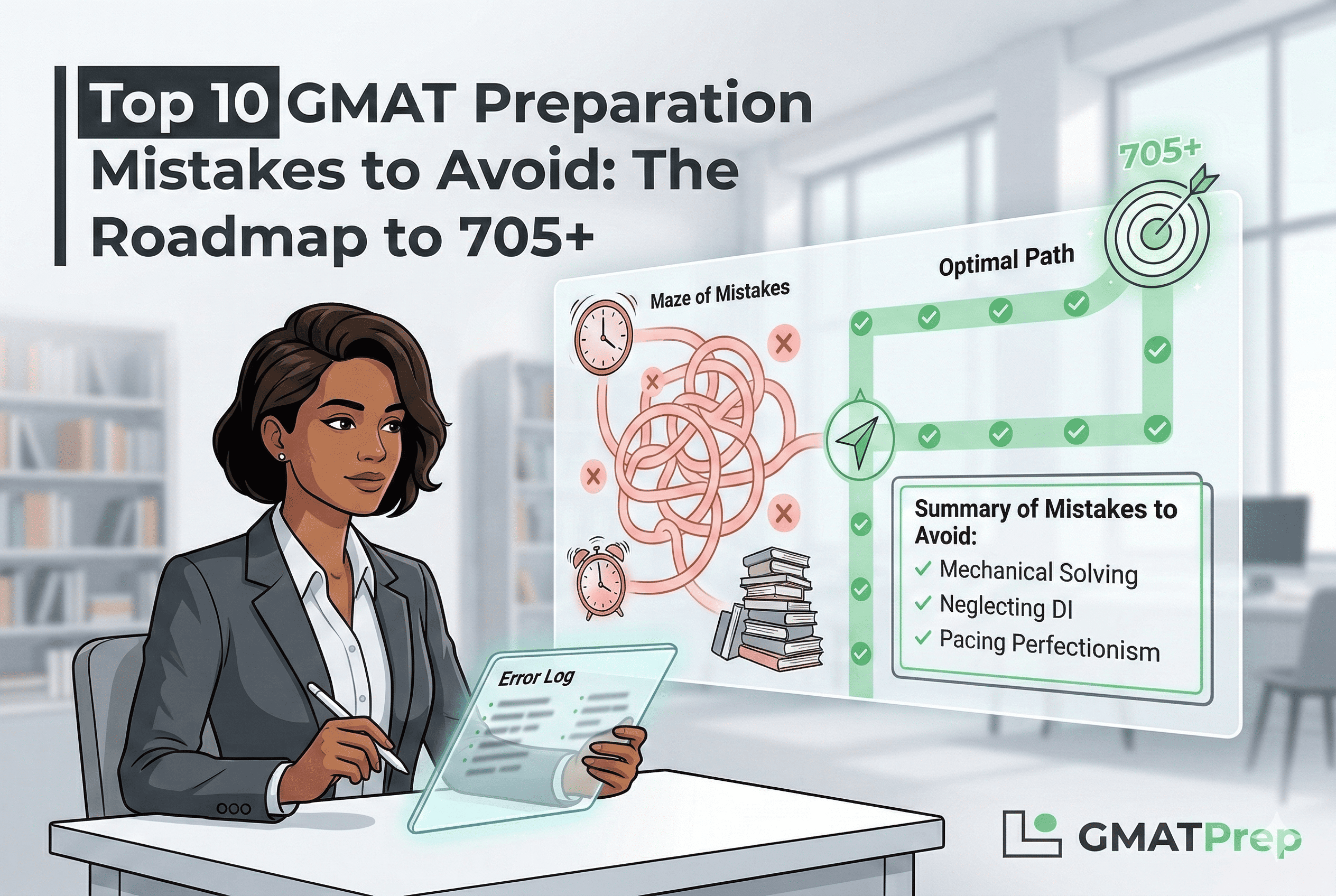
The GMAT Focus Edition is more than a hurdle for MBA admissions; it is a sophisticated assessment of executive decision-making. Yet, many high-potential candidates find themselves plateauing far below their target scores. Often, the issue isn’t a lack of effort, but rather “Strategic Friction”—effort misapplied in ways that actually hinder progress.
Success in the modern GMAT landscape is defined as much by what you don’t do as by what you do. If you are starting your journey or looking to break a score ceiling, these are the top 10 mistakes to eliminate from your study routine, along with essential GMAT preparation tips to replace them with winning habits.
1. Treating the GMAT Like a Content-Based University Exam
The single most common mistake is approaching the GMAT as if it were a high school math or grammar test. Many students spend months memorizing obscure vocabulary or complex geometric proofs (many of which are no longer even on the Focus Edition).
The Reality: The GMAT is a test of Applied Logic. The Quantitative section isn’t testing your ability to do math; it’s testing your ability to use numbers to solve a logical puzzle. The Verbal section isn’t testing your “ear” for English; it’s testing your ability to deconstruct an argument’s architecture.
The Fix: Shift your focus from “What is the rule?” to “How is this rule being used to hide the answer?” Master the foundational concepts, but spend the majority of your time on “Logical Inferences.”
2. Neglecting Data Insights (The “New Pillar”)
Because Data Insights (DI) is the newest addition to the core GMAT score, many aspirants treat it as an afterthought, focusing 90% of their energy on Quant and Verbal.
The Reality: Data Insights is one-third of your total score. It requires a unique hybrid of Quant logic and Verbal comprehension. Furthermore, DI questions like Multi-Source Reasoning and Table Analysis are “Time Sinks” that can derail your entire testing rhythm if you haven’t practiced them specifically.
The Fix: Integrate DI into your GMAT preparation tips from Week 1. Do not wait until you “finish” Quant and Verbal. Practice the “Synthesis” of information across multiple tabs and charts to build the specific cognitive endurance this section demands.
3. Prioritizing Question “Quantity” Over Review “Quality”
There is a common myth that solving 5,000 questions guarantees a 705+. This leads to “Mechanical Solving”—rushing through problems just to check them off a list without truly understanding the underlying mechanics.
The Reality: Solving 10 questions and performing a “Forensic Review” on each is 10x more effective than solving 100 questions and only checking if you got the answer right.
The Fix: For every question you get wrong (and even the ones you get right but took too long on), ask:
- What was the “Trigger” for the correct path?
- What was the “Trap” in the wrong answer I chose?
- How could I have solved this in under 90 seconds?
4. Avoiding the “Cold” Diagnostic Mock
Many students refuse to take their first mock test until they feel “ready.” They spend weeks studying before seeing where they stand, fearing that a low initial score will kill their motivation.
The Reality: Without a baseline, you are studying in the dark. You might be over-studying areas where you are naturally strong (like Arithmetic) while neglecting areas where you have deep-seated logic gaps (like Critical Reasoning).
The Fix: Take an official-style diagnostic mock on Day 1. Use the data to build a “Surgical Study Plan” that targets your specific weaknesses. A 505 baseline is not a failure; it is a map.
5. Failing to Maintain a Rigorous Error Log
If you don’t track your mistakes, you are doomed to repeat them. Most students “review” a mistake by reading an explanation, saying “I get it now,” and moving on. Two weeks later, they make the exact same error on a different question.
The Reality: The GMAT tests the same logical patterns over and over. An error log is the only way to recognize those patterns before you fall into them on test day.
The Fix: Your error log must be more than a list of questions. It should categorize mistakes by:
- Concept Gap: (e.g., I didn’t know the rule for Absolute Values).
- Execution Gap: (e.g., I knew the rule but did the calculation wrong).
- Logical Gap: (e.g., I misread the ‘conclusion’ of the argument).
6. The “Perfectionist” Trap: Lack of a Pacing Strategy
Many high-achieving candidates struggle with “letting go.” They stay on a difficult question for 4 or 5 minutes, determined to solve it, believing that getting every question right is the only way to a top score.
The Reality: The GMAT algorithm penalizes “Time Debt” more than it penalizes a single wrong answer. If you spend 5 minutes on one question, you will be forced to guess on the last four questions of the section, which will tank your score much harder than one strategic miss.
The Fix: Implement the “2-Minute Rule.” If you don’t have a clear path to the solution by the 90-second mark, make an educated guess, bookmark it, and move on.
7. Using Low-Quality Unofficial Practice Materials
In an effort to find more “free” content, many aspirants use question banks that do not mirror the official GMAT logic.
The Reality: “Bad” questions often rely on “Fake Difficulty”—calculations that are unnecessarily long or Verbal answers that are a matter of opinion rather than objective logic. Practicing with these trains your brain to look for the wrong things.
The Fix: Stick to official GMAT Focus materials and high-fidelity prep platforms that use calibrated Item Response Theory (IRT) algorithms. GMAT preparation tips are only as good as the data they are based on.
8. Inconsistent Study Habits (The “Sunday Warrior” Syndrome)
Many working professionals try to “cram” all their GMAT prep into a single 8-hour session on Sunday.
The Reality: The GMAT is about “Neural Plasticity.” Your brain needs consistent, daily exposure to logical patterns to make them intuitive. Studying for 1 hour a day for 6 days is vastly superior to studying for 6 hours in 1 day.
The Fix: Use “Habit Stacking.” Study for 45 minutes before work or during your commute. Consistency keeps the logical pathways “warm,” allowing you to solve problems faster and with less effort.
9. Overlooking Mental Fatigue and “Tapering”
Some candidates study with 100% intensity right up until the night before the exam. They arrive at the test center mentally exhausted.
The Reality: The GMAT is a cognitive marathon. If you haven’t allowed your brain to recover, your ability to spot subtle logical traps will be significantly diminished.
The Fix: Treat the final week like an athlete prepares for a race. Reduce your intensity (“Tapering”). Focus on light reviews of your error log and “Confidence Builders” (Easy/Medium questions). Stop studying entirely 24 hours before the exam.
10. Ignoring the “Review & Edit” Feature
The Focus Edition introduced the ability to change up to three answers at the end of a section. Many students either forget this exists or use it recklessly.
The Reality: This feature is a safety net, not a crutch. If you use it to “second-guess” yourself out of anxiety, you will likely change right answers to wrong ones.
The Fix: Only change an answer if you found a definitive logical or calculation error during your final review. Use the “Bookmark” feature during the section to identify exactly which questions are worth your time in those final minutes.
Conclusion: Skill Mastery Over Rote Learning
Achieving a 705+ on the GMAT Focus Edition is not about how much you know; it is about how you execute under pressure. By avoiding these ten common pitfalls, you clear the path for your natural logic and analytical skills to shine.
Success is a process of refinement. It’s about building a foundation of concepts, layering on a ruthless pacing strategy, and constantly auditing your performance through a forensic review of your mistakes.
Ready to see where your logic stands?
The best way to identify your specific “blind spots” is through targeted practice. Don’t wait until your next full mock to test your skills. Dive into our curated question sets to see if you’re falling into common traps or mastering the official logic.
Leave a Reply