Let’s be honest: the GMAT Quant section can feel like a high-stakes puzzle where the pieces keep changing shape while you’re trying to fit them together. You might know your prime numbers from your permutations, but when that clock starts ticking, the pressure of the GMAT algorithm can make even a simple algebraic equation look like ancient hieroglyphics.
The secret to a 705+ score isn’t just knowing the math; it’s knowing how to handle the math under the specific constraints of the exam. This is where GMAT quant mocks become your most powerful weapon. They aren’t just tests of your knowledge; they are simulations of your psychological and strategic discipline.
In this guide, we will break down the focused strategies you need to master quantitative mock tests, from understanding the item-adaptive engine to avoiding the “Hero Complex” that destroys pacing.
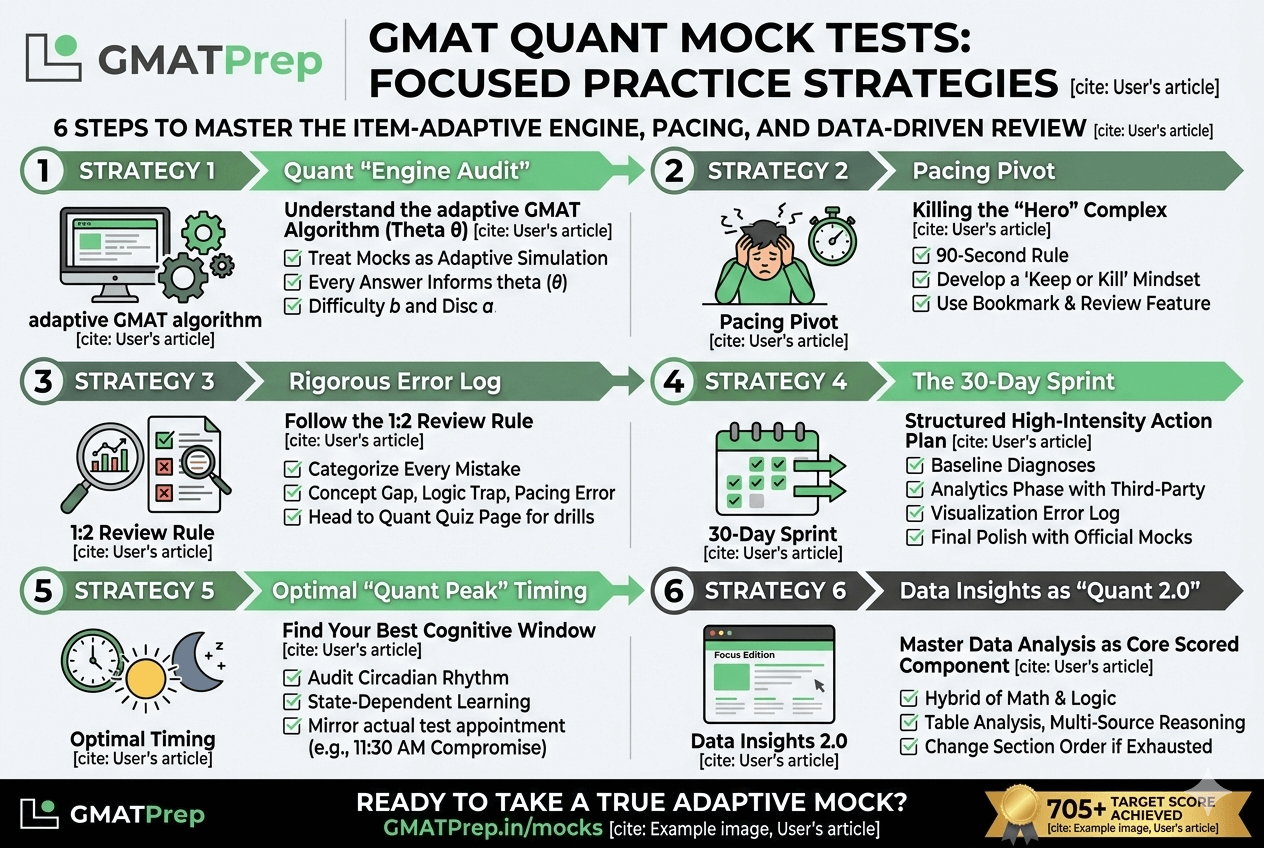
1. Understanding the Quant “Engine”
The GMAT is not a linear test; it is a computer adaptive test (CAT). In the Quant section, every answer you submit informs the computer’s estimate of your ability, known as “Theta”.
The Difficulty Calibration
Every question has specific parameters:
- Difficulty: The level where you have a 50% chance of success.
- Discrimination: How well the question separates high-ability from low-ability students.
If you get a question right, the algorithm reaches into the “item pool” for a more challenging problem. If you miss it, the difficulty drops. This means that in GMAT math practice, you can’t just count how many you got right; you have to look at the difficulty of the questions you were facing when you missed them.
Why Adaptation Matters for Quant
Because the GMAT is item-adaptive—meaning it re-evaluates you after every single question—the Quant section feels like an uphill climb. As you perform better, the math gets more complex, testing not just your calculation speed but your ability to recognize logic traps under stress.
2. The Pacing Pivot: Killing the “Hero” Complex
One of the most frequent GMAT preparation mistakes is the “Hero” Complex: the belief that you must solve every hard Quant problem because you are a “math person”.
The 90-Second Rule
In a high-quality score improvement plan, you must develop a “Keep or Kill” mindset.
- If you are 90 seconds into a Quant problem and haven’t identified the “path to solution” (e.g., setting up the equation x/y = z/w, you must stop.
- The penalty for not finishing the section is far more severe than the cost of missing one difficult item.
Using the Review Feature
The GMAT Focus Edition allows you to bookmark questions and change up to three answers at the end of a section. In your GMAT quant mocks, use this strategically. If a geometry problem involving $a^2 + b^2 = c^2$ is taking too long, bookmark it, make an educated guess, and move on. You can return to it later if you have time left, rather than sacrificing the final five questions of the section.
3. Advanced Tactical Review: The 1:2 Rule
Taking quantitative mock tests without a rigorous review is essentially a waste of time. To truly improve GMAT mock score results, you must follow the 1:2 Rule: spend two hours reviewing for every one hour of testing.
Categorizing Quant Errors
When reviewing your math practice, place every mistake into a specific “bucket”:
- Concept Gap: You didn’t know the formula or the property (e.g., forgetting that 1 is not a prime number).
- Logic Trap: You solved the wrong thing (e.g., solving for x when the question asked for x+y.
- Pacing Error: You rushed a simple calculation because you were behind on time.
For every Concept Gap, head over to the Quant quiz page to do 10–20 targeted drills on that specific topic until the math becomes second nature.
4. The 30-Day Quant Sprint
To increase GMAT score outcomes in the Quantitative section, you need a structured timeline. You can’t cram math logic; you have to build it.
- Days 1–5 (The Baseline): Take a diagnostic mock to find your “natural” Quant floor.
- Days 6–15 (The Analytics Phase): Use third-party GMAT quant mocks to find your “Stamina Drop-off”. Do you start making more errors 30 minutes into the math section?.
- Days 16–25 (Simulation): Practice in the exact same environment you will face at the test center—no calculator, no music, and a laminated scratchpad.
- Days 26–30 (Final Polish): Re-test with official mocks to calibrate your brain to the “Official GMAC Voice”.
Check our full Mock test page for the adaptive tools necessary to execute this plan.
5. Finding Your “Quant Peak” Timing
The time of day you choose for your GMAT math practice can significantly impact your results. Logical reasoning—the core of GMAT Quant—typically peaks when your body temperature is rising in the morning.
Chronotype Strategy
- Morning Birds: If you are a “Lark,” your optimal test time for Quant is early morning, when your processing speed is highest.
- Evening Owls: If you take your mocks at 9:00 PM after a full workday, you are battling “Decision Fatigue”. This leads to more “careless” errors on math problems you actually know how to solve.
Always aim to take your most important GMAT quant mocks at the same time as your actual exam appointment to benefit from “State-Dependent Learning”.
6. Mastering Data Insights as “Quant 2.0”
In the Focus Edition, Data Insights (DI) is a core, scored section that heavily leverages your quantitative skills. One of the biggest GMAT preparation mistakes is treating DI as an elective.
DI requires a hybrid of math and logic. If you find yourself exhausted by the time you reach DI in your mocks, try changing your section order. Moving Quant or DI to the first slot can help you tackle the most “math-heavy” portions of the exam while your brain is still fresh.
Conclusion: Strategy Over Speed
A high score on GMAT quant mocks is not awarded to the person who calculates the fastest; it is awarded to the person who manages their “Decision Budget” most effectively. By understanding the adaptive algorithm, killing your “Hero Complex,” and reviewing your errors with the 1:2 Rule, you turn the Quant section from a source of anxiety into a source of points.
Ready to see if your pacing is actually holding you back? Visit our Mock test page to take a full-length, adaptive mock. Our advanced analytics will tell you exactly where your “Theta” is dropping and which math topics need another round of drills on our Quant quiz page.
Would you like me to create a Quant-specific pacing chart that you can print out and keep next to your scratchpad during your next mock?
Leave a Reply